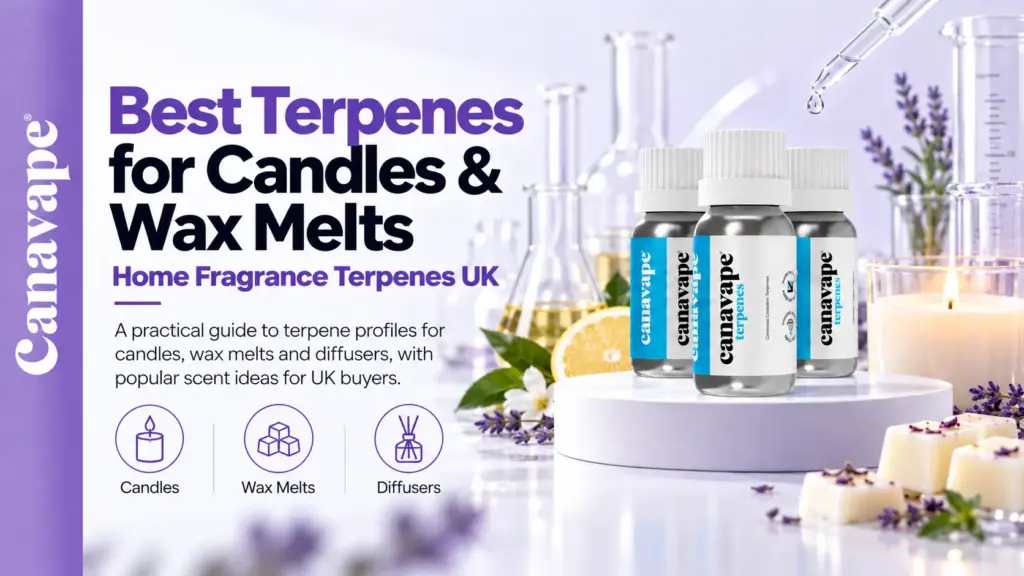
Si estás buscando los mejores terpenos para velas y pastillas de cera, lo primero debe ser el aroma.
Los terpenos ofrecen un enfoque muy diferente a la hora de perfumar el hogar, más allá de la simple elección de otro aceite perfumado convencional. Son las moléculas aromáticas responsables de muchas de las notas reconocibles de cítricos, frutas, pino, flores, hierbas, madera y especias que se encuentran de forma natural en las plantas.
Además, son responsables de gran parte del aroma característico asociado al cannabis.
Esto hace que los perfiles de terpenos resulten especialmente interesantes para los fabricantes de velas y los creadores de fórmulas para ceras fundidas que buscan crear algo que vaya más allá de las fragancias habituales de vainilla, lavanda y frutas genéricas.
Un perfil de terpenos bien diseñado puede aportar notas de jugosas frutas tropicales, cáscara de cítricos fresca, dulzor de bayas, notas herbáceas verdes, pimienta, pino, toques terrosos y el complejo carácter aromático asociado a las variedades de cannabis más famosas.
Es importante destacar que un aroma de terpenos inspirado en el cannabis no tiene por qué contener THC, CBD o material vegetal de cannabis.
Los terpenos botánicos que se encuentran en los cítricos, las hierbas, las flores, las especias y otras plantas pueden combinarse para recrear perfiles aromáticos inspirados en determinadas variedades.
En lo que respecta al desarrollo de velas y ceras fundidas, esto abre un amplio abanico de posibilidades de fragancias poco habituales.
En esta guía comparamos nuestros tres perfiles de terpenos favoritos de Canavape para velas y ceras aromáticas: Purple Punch Mints 11, Mango Kush y Super Lemon Haze.
También explicamos qué hace que un perfil de terpenos sea adecuado para la fragancia para el hogar, en qué se diferencian los terpenos de los aceites esenciales y de los aceites de fragancia convencionales, qué ocurre cuando se calientan los compuestos aromáticos y cómo elegir el mejor perfil para el tipo de aroma que quieras crear.
Nuestros tres perfiles de terpenos estrella para velas y ceras fundidas son Purple Punch Mints 11, con aromas dulces a bayas y cremosos de estilo «gourmand»; Mango Kush, con notas de frutas tropicales y un fondo terroso y herbal; y Super Lemon Haze, con un carácter brillante a limón, cítricos y notas botánicas frescas. Cada uno de ellos crea una línea de fragancias inspirada en el cannabis claramente diferenciada, lo que los convierte en un excelente punto de partida para los fabricantes de velas que buscan algo más original que los perfiles de fragancias tradicionales.
Tres perfiles de terpenos contrastantes para una fragancia para el hogar inspirada en el cannabis.
| Perfil de terpenos | Dirección de aromas | Lo mejor para | Nuestra elección |
|---|---|---|---|
| Caramelos de menta Purple Punch 11 | Notas dulces de bayas y uva, cremosas y con un suave toque herbal | Velas con aromas golosos, pastillas de cera con aroma a frutos del bosque, fragancias más intensas para la noche | El mejor perfil de dulzor |
| Mango Kush | Mango tropical, fruta, hierbas y un fondo terroso | Velas tropicales, fragancias botánicas para el hogar, pastillas de cera exóticas | El mejor todoterreno |
| Super Lemon Haze | Ralladura de limón, cáscara de cítricos, hierbas, ligeras notas florales y especias | Velas nuevas, pastillas de cera con aroma a cítricos, fragancias frescas y revitalizantes | El mejor perfil de «fresco» |
Si tu idea para una vela es dulce, afrutada, cremosa o de estilo «gourmand», Purple Punch Mints 11 es nuestra primera opción.
Su perfil aromático se sitúa en un ámbito muy distinto al de los cítricos o las frutas tropicales en sí.
Imagina frutas de color morado oscuro, el dulzor de las bayas, notas que recuerdan a la uva y un fondo cremoso con la complejidad herbal suficiente para evitar que el aroma se convierta en una simple fragancia de repostería.
Ese contraste hace que las pastillas de menta Purple Punch resulten especialmente interesantes para el desarrollo de velas y ceras fundidas de alta gama.
En lugar de oler a una fragancia frutal convencional, ofrece ese carácter aromático con múltiples matices propio de la perfumería moderna inspirada en el cannabis.
Elegiríamos las pastillas de menta Purple Punch Mints 11 por:
Resulta especialmente útil cuando quieres que una vela transmita una sensación de lujo sin recurrir simplemente a la vainilla, el caramelo o las fragancias dulces convencionales.
Comprar caramelos de menta Purple Punch con 11 terpenos
Purple Punch Mints 11 se caracteriza por un perfil frutal dulce muy característico, basado en notas de uva y bayas, con un fondo cremoso, ligeramente floral y herbal.
En el ámbito de las fragancias para el hogar, el atractivo reside en el contraste.
Las notas de salida y de corazón, más dulces, pueden transmitir una sensación de familiaridad inmediata, mientras que los elementos botánicos más profundos aportan a la fragancia un toque considerablemente más sofisticado.
Esto lo hace especialmente interesante para los creadores que intentan elaborar una vela con aroma a cannabis que no se limite simplemente a oler verde, a hierba o a humo.
When designing a broader fragrance accord, Purple Punch Mints can sit naturally alongside directions such as:
The objective is not necessarily to make the cannabis inspiration obvious.
A terpene profile can simply be used as an unusual aromatic building block.
Mango Kush is probably the most versatile of our three recommendations.
It combines recognisable sweet tropical mango with earthy and herbal undertones.
That gives the profile immediate fruit appeal while retaining enough botanical depth to distinguish it from an ordinary mango fragrance.
For candle making, this makes Mango Kush particularly easy to build a concept around.
It can be taken in a bright tropical direction, made deeper and earthier, paired with other fruits or used as the main character in a cannabis-inspired fragrance.
We would choose Mango Kush for:
Mango Kush is led by sweet tropical mango aromas supported by earthy and herbal character.
This combination is important.
A pure mango fragrance can become extremely sweet.
The earthier side of Mango Kush provides contrast and helps create a fragrance that feels botanical rather than simply confectionery.
The profile contains aromatic contributors associated with myrcene, beta-caryophyllene, humulene and ocimene, creating a mixture of fruit, herbs, spice and natural depth.
Home fragrance often benefits from immediate recognition.
A customer understands mango instantly.
What they may not expect is mango combined with an earthy, herbal cannabis-inspired background.
That gives a maker an easy marketing concept while still delivering something unusual.
A Mango Kush candle can therefore appeal both to people actively looking for cannabis-inspired fragrance and to customers who simply enjoy tropical botanical scents.
Potential complementary fragrance directions include:
It can therefore move from bright tropical fruit towards something much deeper depending on the surrounding fragrance composition.
For a fresh, bright and immediately recognisable aroma, Super Lemon Haze is our citrus choice.
The profile opens with lemon zest and citrus peel before moving into herbal, lightly floral, spicy and earthy territory.
This makes it significantly more complex than simply using a generic lemon scent.
Super Lemon Haze is particularly useful when you want a home fragrance to feel clean, botanical and modern.
We would choose Super Lemon Haze for:
Shop Super Lemon Haze Terpenes
Super Lemon Haze is dominated by sharp lemon and sweet citrus character.
Underneath this are herbal freshness, light floral character, spice and mild earthiness.
Rather than smelling like a household lemon fragrance, the supporting terpene character gives it a much more botanical identity.
Limonene contributes heavily to the bright citrus direction, while terpinolene, myrcene, beta-caryophyllene, humulene and other aromatic compounds add additional layers.
Citrus is one of the most familiar fragrance families in the world.
It can make a room fragrance feel immediately fresh and recognisable.
Terpene profiles allow a formulator to move beyond a one-dimensional lemon smell by incorporating herbal, woody, floral and spicy character around that citrus centre.
However, lighter citrus terpenes are also relatively volatile.
This means a citrus-led candle or wax melt should always be evaluated in the actual wax system rather than judged only by how the terpene concentrate smells from the bottle.
Useful complementary directions include:
| If You Want… | Elija | Por qué |
|---|---|---|
| Sweet berry and grape aroma | Caramelos de menta Purple Punch 11 | Rich, fruity and gourmand with botanical complexity |
| Frutas tropicales | Mango Kush | Recognisable mango supported by herbs and earthiness |
| Fresh lemon and citrus | Super Lemon Haze | Bright lemon with herbal, floral and spicy depth |
| A darker candle concept | Caramelos de menta Purple Punch 11 | Works naturally with berries, woods and richer accords |
| A summer collection | Mango Kush | Tropical direction is easy to understand and market |
| A fresh modern scent | Super Lemon Haze | Clean citrus profile with recognisable botanical character |
| Your first terpene candle experiment | Mango Kush | Our most versatile all-round recommendation |
Most candle makers begin with conventional fragrance oils because they are readily available and easy to understand.
Terpenes offer another route.
They can introduce aromatic characteristics directly connected with plants and botanical chemistry.
For makers trying to create distinctive fragrance collections, this provides several advantages.
Cannabis-inspired strain profiles can combine fruit, citrus, herbs, earth, flowers, woods and spice in combinations that are difficult to describe using conventional candle-fragrance categories.
Names such as Mango Kush and Super Lemon Haze already communicate an aromatic idea.
This can provide a strong starting point for creative product development.
Terpenes allow fragrance concepts to move beyond a single dominant note.
A lemon profile can contain herbal and woody dimensions.
A mango profile can include earthy depth.
A berry profile can have floral and botanical character.
Cannabis aroma has moved well beyond novelty products.
Modern fragrance design increasingly treats green, herbal, resinous and cannabis-inspired notes as sophisticated aromatic directions in their own right.
Suitable terpene ingredients can form part of a properly developed candle fragrance system.
The important distinction is that concentrated terpene ingredients should not automatically be treated as finished candle fragrance oils.
Candle performance depends on the complete formulation.
Variables include:
For this reason, there is no single universal terpene percentage that should be copied into every candle.
Read our broader guide to Cómo utilizar los terpenos before beginning formulation work.
Yes, suitable terpene-containing fragrance systems can also be developed for wax melts.
Wax melts are particularly interesting because they create aroma through a heated wax pool without a wick burning directly within the formulation.
They still expose aromatic ingredients to heat, so volatility and stability remain important.
A profile that smells excellent at room temperature can smell different once warmed.
This is why wax-melt development should include evaluation of the actual heated product.
The same three profiles work well as starting points for wax-melt concepts, but each creates a very different collection.
Best suited to sweet berry, dark fruit, creamy and gourmand styles.
This would be our choice for a premium collection designed around deeper, more indulgent fragrance.
A strong choice for tropical and botanical wax melts.
The combination of mango and earthier character means it can remain interesting after the immediate fruit note has been established.
Ideal for citrus-led fragrance concepts.
The herbal background helps differentiate it from a simple lemon wax melt.
No.
A conventional candle fragrance oil can contain a complex formulation of natural and synthetic aromatic substances designed specifically for fragrance use.
Un terpeno aislar is a defined aromatic compound.
A terpene profile is a mixture of aromatic compounds selected to create a particular character.
They overlap in fragrance chemistry, but the terms are not interchangeable.
| Característica | Perfil de terpenos | Conventional Fragrance Oil |
|---|---|---|
| Aroma concept | Botanical or strain-inspired | Almost unlimited |
| Composición | Terpenes and related aromatic compounds | Can contain many different aroma chemicals |
| Cannabis-inspired potential | Excelente | Possible, depending on formulation |
| Ready for candle use | Depends on the supplied ingredient and finished formulation | Many are specifically sold for candle formulation |
| Creative control | Excellent for botanical profile development | Excellent where a finished fragrance accord is preferred |
No.
An essential oil is normally a naturally extraído mixture containing numerous volatile compounds from a particular botanical source.
A single terpene isolate may contain one principal molecule.
A terpene profile combines selected aromatic compounds to create a particular sensory profile.
Essential oils themselves often contain substantial quantities of terpenes and terpenoids, which is why the two areas of chemistry overlap.
Ninguna de las dos categorías es automáticamente mejor.
The choice depends on the desired fragrance and finished-product design.
Essential oils can provide a native botanical extract.
Terpene profiles allow considerably more control over the aromatic direction and make it possible to recreate scent profiles not available as conventional essential oils.
There is no Mango Kush essential oil distilled from a mango fruit.
Mango Kush is an aromatic profile.
That is exactly where terpene formulation becomes interesting.
A cannabis-inspired candle is a home-fragrance product designed to recreate aromatic characteristics associated with cannabis cultivars.
That does not mean it needs to contain cannabis.
Cannabis produces many of the same terpene molecules found throughout other plants.
Examples include limonene, myrcene, pinene, beta-caryophyllene and linalool.
By combining lawful botanical ingredients in selected proportions, a fragrance profile can reproduce aspects of cannabis aroma without containing THC or cannabis plant material.
This distinction is useful because the terms are frequently confused.
| Plazo | What It Usually Means |
|---|---|
| Cannabis-inspired candle | A fragrance designed to resemble cannabis or a particular cultivar |
| Cannabis-scented candle | A candle whose aroma evokes cannabis |
| Cannabis-infused candle | Could imply the finished product actually contains a cannabis-derived material |
| Terpene candle | A candle fragrance system incorporating terpene ingredients |
For botanical Canavape profiles such as Super Lemon Haze, the clearest description is normally cannabis-inspired or strain-inspired.
No necesariamente.
Scent does not establish cannabinoid content.
A botanical terpene profile can reproduce cannabis-associated aroma while containing no THC at all.
The chemistry responsible for aroma is separate from the cannabinoid chemistry responsible for THC content.
Nuestra guía sobre Terpenos frente al THC explains the difference.
They can, but there is no single universal cannabis smell.
Different cannabis cultivars can smell dramatically different.
One profile may be dominated by citrus.
Another may smell fruity and sweet.
Others can lean towards pine, herbs, earth, flowers, spice or resinous character.
This diversity is precisely why strain-inspired terpene profiles work so well as fragrance ideas.
Cannabis produces numerous volatile compounds in different proportions.
Different cultivars therefore develop different aromatic fingerprints.
Major terpenes contribute strongly, but trace terpenoids and non-terpene volatile compounds can also influence aroma.
Leer ¿Qué son los terpenos del cannabis y la hierba? para conocer los detalles químicos.
There is more to choosing terpenes for candles than selecting the strongest-smelling bottle.
The profile should communicate an obvious aromatic direction.
Mango Kush has tropical fruit.
Super Lemon Haze has citrus.
Purple Punch Mints offers sweet darker fruit.
A good home fragrance should remain interesting after the first impression.
Supporting herbal, woody, floral, earthy or spicy notes can prevent a fragrance from feeling one-dimensional.
A bright citrus profile may suit a spring collection.
A richer berry profile may be better for autumn or winter.
The best profile is the one that fits the finished product.
Commercial candle makers need the same fragrance to be reproducible across future batches.
Consistent terpene profiles make that considerably easier.
Profiles can be combined during controlled fragrance development.
This opens up considerably more creative territory.
For example, a tropical Mango Kush direction could potentially be given a brighter citrus edge by introducing elements inspired by Super Lemon Haze.
A darker Purple Punch Mints concept could be contrasted against fresh citrus or woods.
Whenever aromatic ingredients are combined, however, the resulting composition becomes a new formulation.
Its aroma, performance and safety classification should be considered as a whole.
Terpene ingredients can potentially be incorporated into broader fragrance compositions where the materials are compatible and appropriate for the finished application.
This means the choice does not necessarily need to be terpenes or fragrance oils.
A terpene profile can become one part of a larger fragrance accord.
This can be particularly effective when a maker wants authentic botanical character but also needs other fragrance notes that are difficult to construct using terpenes alone.
Suitable aromatic formulations can be developed for soy wax.
The finished fragrance system needs to be tested in the actual wax because solubility, fragrance retention, wick behaviour and scent throw are properties of the complete candle.
Do not assume that a fragrance performing well in one wax will behave identically in another.
Se aplica el mismo principio.
Coconut-based wax systems can support sophisticated fragrance formulations, but the complete aromatic blend should be tested for compatibility and performance.
Suitable fragrance systems can also be developed for rapeseed wax and rapeseed-containing blends.
Again, test the finished formulation rather than transferring a formula blindly from another wax.
Terpene-containing fragrance compositions can potentially be incorporated into paraffin systems where the aromatic ingredients are suitable for that application.
The actual fragrance system, wax, wick and production process still need to be evaluated together.
Beeswax presents an additional sensory consideration because the wax itself already has a recognisable natural aroma.
This means the selected terpene profile needs to work with rather than fight against that background scent.
Richer botanical, woody or fruit profiles may behave differently from very delicate fragrance concepts.
A candle creates a complex thermal environment.
The wax pool warms aromatic ingredients and encourages their evaporation.
Closer to the flame, considerably higher temperatures occur.
It is therefore misleading to describe candle fragrance simply in terms of one terpene boiling point.
Terpenes can evaporate well below their normal boiling temperatures, and some can undergo chemical change when exposed to sufficient heat.
Read our dedicated guide to temperaturas de evaporación, combustión y degradación de los terpenos.
Candle makers normally evaluate fragrance in two very different conditions.
Cold throw describes the aroma of the candle while unlit.
This matters because it is often the customer’s first sensory experience.
Hot throw describes how fragrance is perceived while the candle is burning and the wax pool is warm.
A terpene profile with an impressive cold aroma does not automatically guarantee identical hot performance.
This is why real candle testing remains necessary.
Not necessarily better, but they offer a different formulation environment.
Wax melts release fragrance from warmed wax without a wick burning directly in the formulation.
This can make them an attractive format for experimental home fragrance.
They still involve heat and therefore still require stability and sensory testing.
There is no single best cannabis scent because cannabis aroma covers a surprisingly amplio espectro.
Three easy starting categories are:
Choose Purple Punch Mints 11.
Choose Mango Kush.
Choose Super Lemon Haze.
These three profiles demonstrate why cannabis-inspired fragrance should not be reduced to one generic green or herbal smell.
Purple Punch Mints 11 is our first recommendation.
Its dark-fruit and creamy character lends itself naturally to sweeter candle concepts.
Mango Kush is the obvious starting point.
The mango-led aroma creates immediate tropical recognition while the earthy and herbal background provides additional depth.
Super Lemon Haze is our preferred option.
It gives a lemon-led fragrance considerably more complexity than a simple citrus isolate alone.
All three qualify, but Purple Punch Mints 11 probably creates the most unexpected result.
The combination of dark fruit, creamy sweetness and botanical complexity provides a scent direction consumers are unlikely to encounter in conventional high-street candle ranges.
If the objective is explicitly cannabis-inspired fragrance, we would begin by deciding what style of cannabis aroma you actually want.
For a sweet cultivar-style aroma, choose Purple Punch Mints.
For tropical cannabis character, choose Mango Kush.
For sharp citrus Haze-style aroma, choose Super Lemon Haze.
This is a more useful approach than searching for one generic “weed smell”.
No.
Common terpene molecules do not independently create the conventional intoxicating high associated with THC.
A candle containing a lawful botanical terpene profile does not become psychoactive merely because the profile is inspired by cannabis.
Leer ¿Los terpenos te colocan? for the complete scientific explanation.
Common terpene molecules such as limonene, myrcene, pinene and beta-caryophyllene are generally legal en el Reino Unido.
They are not controlled drugs simply because they also occur naturally in cannabis.
Botanical strain-inspired profiles therefore have a relatively straightforward controlled-drug position.
Cannabis-derived ingredients require additional consideration because of their source and potential cannabinoid content.
Leer are terpenes legal in the UK? para ver la explicación completa.
Legal terpene ingredients are not exempt from ordinary product and chemical safety requirements.
Where a commercial fragrance mixture or other chemical mixture is placed on the Great Britain market, its actual finished composition may need to be classified and labelled under the applicable GB chemical framework.
The classification depends on the ingredients and their concentrations.
This is another reason professional makers should retain supplier documentation for the aromatic materials they use.
The practical point for this article is simple: choose the aroma first, but assess the finished product as a finished product.
Safety depends on the exact chemical composition, concentration and finished formulation.
Natural origin does not mean unlimited concentrations are automatically safe.
Concentrated terpene ingredients can have classifications involving irritation, sensitisation, flammability or environmental hazards.
Leer ¿Son seguros los terpenos? a nuestro guía, que se ha volcado en su trabajo.
Terpenes can change when exposed repeatedly to oxygen.
Oxidation may affect both aroma and the chemical composition of the material.
This is one reason concentrated terpene profiles should be stored correctly before they are incorporated into a finished fragrance system.
Follow the supplier’s storage specification.
General principles include:
Leer Cómo almacenar y conservar los terpenos para consultar la guía completa de almacenamiento.
Both categories can offer interesting aromatic material, but they are fundamentally different sources.
These are constructed using terpene ingredients obtained from non-cannabis botanical sources.
Ofrecen:
These are obtained directly from cannabis material.
They can preserve native cultivar character and minor volatile complexity but require more attention to source and cannabinoid composition.
For most candle makers simply trying to create a cannabis-inspired fragrance, botanical strain profiles are the most straightforward starting point.
Leer Terpenos botánicos frente a terpenos derivados del cannabis para ver la comparación completa.
They can contribute recognisable botanical aromatic compounds, but “natural smelling” is subjective.
A sophisticated fragrance depends on the entire composition rather than whether every molecule came directly from a plant.
A poorly balanced natural mixture can smell less convincing than a carefully designed fragrance.
Good formulation matters more than simply placing the word natural on the ingredients.
No de forma automática.
Natural describes origin.
It does not guarantee better safety, stronger hot throw, greater stability or superior aroma.
The best ingredient is the one that meets the required specification and performs correctly in the intended candle or wax-melt system.
A three-profile collection could be built immediately around the recommendations in this guide.
Purple Punch Mints 11 as the sweet, dark-fruit and gourmand direction.
Mango Kush as the juicy tropical and earthy direction.
Super Lemon Haze as the bright lemon and fresh botanical direction.
Together, those three fragrances would demonstrate very clearly that cannabis-inspired aroma is much broader than a single stereotypical cannabis smell.
When comparing terpenes UK suppliers for candle or wax-melt development, look beyond the strain name.
Useful information includes:
Canavape supplies terpene profiles in multiple quantities, allowing product developers to begin with smaller samples and move towards larger-volume supply as formulations progress.
Browse the complete Colección de terpenos de Canavape for more botanical and strain-inspired profiles.
Canavape has worked with terpene profiles for years across botanical and cannabis-derived aroma chemistry.
Our expanding terpene collection gives makers access to profiles ranging from familiar fruits through to detailed cultivar-inspired aromas.
For candle, wax-melt, diffuser and fragrance development, that breadth creates the opportunity to explore aromatic directions that are difficult to find in conventional home-fragrance catalogues.
You can start with one of the three profiles featured here or explore the wider collection according to your own fragrance concept.
| Rank | Perfil | Mejor uso |
|---|---|---|
| 1 | Mango Kush | Best all-round starting point for tropical and botanical candle fragrance |
| 2 | Caramelos de menta Purple Punch 11 | Best for sweet, berry, grape and gourmand-style wax products |
| 3 | Super Lemon Haze | Best for bright citrus, lemon and fresh botanical candle concepts |
If you are completely new to terpene-based home fragrance, Mango Kush is the profile we would start with.
If you want something unusual and premium, choose Purple Punch Mints 11.
If you want immediate freshness and recognisable citrus, choose Super Lemon Haze.
What are the best terpenes for candles?
Our three recommendations are Mango Kush for tropical and earthy fragrance, Purple Punch Mints 11 for sweet berry and creamy gourmand character, and Super Lemon Haze for bright lemon and citrus aromas. Can you use terpenes in candles?
Suitable terpene ingredients can form part of a properly developed candle fragrance system. Concentrated terpene profiles should not automatically be treated as finished candle fragrance oils, so compatibility and finished-product performance should be assessed. Can you use terpenes in wax melts?
Yes, suitable terpene-containing fragrance systems can be developed for wax melts. The actual fragrance should be tested in the chosen wax under the intended warming conditions. What is the best terpene for wax melts?
There is no single best profile for every fragrance. Mango Kush is our all-round recommendation, Purple Punch Mints 11 suits sweet and gourmand concepts, and Super Lemon Haze suits fresh citrus wax melts. What terpenes make a candle smell like cannabis?
Cannabis aroma is created by complex combinations of volatile compounds rather than one terpene. Common cannabis terpenes include limonene, myrcene, pinene, beta-caryophyllene and others. Strain-inspired terpene profiles combine multiple compounds to recreate a more complete aroma. Can you make a cannabis scented candle without cannabis?
Yes. Botanical terpenes found in non-cannabis plants can be combined to recreate cannabis-inspired aromatic profiles without the fragrance containing cannabis plant material or THC. Do cannabis scented candles contain THC?
Not necessarily. Aroma and cannabinoid content are separate chemical characteristics. Botanical strain-inspired terpene profiles can reproduce cannabis-associated scents without containing THC. Can a terpene candle get you high?
No. Common terpene molecules do not independently produce the characteristic intoxicating high associated with THC. What is the difference between cannabis-infused and cannabis-inspired candles?
Cannabis-inspired normally describes the aroma or fragrance concept. Cannabis-infused can imply that the product actually contains an ingredient obtained from cannabis. The two terms should not automatically be treated as interchangeable. What does Mango Kush smell like?
Mango Kush has a sweet tropical mango direction supported by earthy and herbal aromatic notes, making it useful for tropical and botanical home-fragrance concepts. What does Super Lemon Haze smell like?
Super Lemon Haze is strongly citrus-led, with lemon zest and citrus peel supported by herbal, lightly floral, spicy and earthy notes. What does Purple Punch Mints smell like?
Purple Punch Mints 11 is associated with sweet dark-fruit, grape and berry character supported by creamy, floral and botanical notes. Which terpene profile is best for sweet candles?
Purple Punch Mints 11 is our first choice for sweet, dark-fruit, berry and gourmand-style candle concepts. Which terpene profile is best for tropical candles?
Mango Kush is our preferred tropical profile because it combines recognisable mango sweetness with earthy and herbal depth. Which terpene profile is best for citrus candles?
Super Lemon Haze is our recommended citrus profile because it combines lemon and citrus peel with herbal, floral and spicy aromatic character. Are terpenes the same as fragrance oils?
No. A terpene profile is a mixture centred on terpene and related aromatic compounds, while conventional fragrance oils can contain a much wider range of natural and synthetic aroma materials. Are terpenes the same as essential oils?
No. Essential oils are complex botanical extracts that can contain many terpenes and other volatile compounds. Terpene profiles can instead be deliberately constructed from selected aromatic ingredients. Can terpenes be mixed with fragrance oils?
Terpene ingredients can potentially form part of wider fragrance compositions where the materials are compatible and appropriate for the finished candle or wax product. Can different terpene profiles be blended together?
Yes, profiles can be combined during controlled fragrance development. The resulting mixture should be treated as a new formulation and assessed accordingly. Do terpenes survive candle heat?
Different terpenes have different volatility and thermal stability. Some aromatic material can be lost or altered during candle production and use, which is why the finished candle should be evaluated rather than relying only on the aroma of the concentrate. Do terpenes evaporate from wax?
Terpenes are volatile aromatic compounds and can gradually evaporate from formulations. Heat generally accelerates the movement of volatile molecules into the surrounding air. Can terpenes be used with soy wax?
Suitable terpene-containing fragrance systems can be developed for soy wax, but the finished formulation should be tested for compatibility, scent throw and candle performance. Can terpenes be used with coco or rapeseed wax?
Potentially, yes. The fragrance system should be developed and tested in the actual wax or wax blend rather than assuming performance will be identical across different wax types. Can terpenes be used with beeswax?
Suitable fragrance compositions can be evaluated in beeswax, although the natural aroma of beeswax itself can influence the resulting scent profile. How much terpene should I put in a candle?
There is no universal terpene percentage suitable for every candle. The appropriate inclusion depends on the exact aromatic ingredient, wax system, complete fragrance formulation and finished-product safety assessment. Are natural terpenes better for candles?
Not automatically. Natural describes origin rather than performance or safety. The best aromatic ingredient is one that meets the required specification and performs properly in the intended formulation. Are terpenes legal for candles in the UK?
Common terpene molecules are generally legal in the UK. Normal chemical and finished-product safety requirements can still apply to commercial candle and fragrance products. Are terpenes safe in candles?
Safety depends on the individual compounds, concentrations and complete finished formulation. Concentrated terpenes should be handled according to their supplier documentation and Safety Data Sheet. Where can I buy terpenes for candles in the UK?
Canavape supplies a wide collection of botanical and strain-inspired terpene profiles in the UK, including Mango Kush, Purple Punch Mints 11 and Super Lemon Haze, with multiple sizes available for product development and larger-volume requirements. Are botanical terpenes good for cannabis-inspired candles?
Yes. Many major cannabis terpenes occur naturally in other plants, allowing botanical ingredients to be combined into detailed cannabis-inspired aroma profiles without requiring cannabis-derived raw material.
Terpenes give candle and wax-melt makers access to an unusually broad botanical fragrance palette.
They can be bright and citrus-heavy, tropical and fruity, sweet and creamy, green and herbal, woody, peppery, floral or earthy.
That makes them particularly interesting for cannabis-inspired home fragrance because there is no single cannabis smell.
Different strain profiles provide completely different aromatic directions.
For our first three recommendations:
If you are beginning with only one profile, Mango Kush is our all-round recommendation.
If you want the most unusual premium fragrance direction, start with Purple Punch Mints 11.
If you want immediate bright freshness, choose Super Lemon Haze.
From there, the wider Canavape collection allows candle makers and fragrance developers to move into fruit, citrus, berries, herbs and increasingly complex cannabis-inspired profiles.
Explore our complete terpenos colección UK to find the profile that fits your next candle, wax melt or home-fragrance concept.
For further formulation background, read Cómo utilizar los terpenos, ¿Son seguros los terpenos?, are terpenes legal in the UK?, Terpenos botánicos frente a terpenos derivados del cannabis, temperaturas de evaporación y degradación de los terpenos y Cómo almacenar y conservar los terpenos.
This article provides general information about terpene selection and home-fragrance development. Concentrated terpene products are formulation ingredients. Always check the specification, Safety Data Sheet and intended-use information for the exact material and assess the completed candle, wax melt or fragrance formulation for its intended market.

Envíanos un mensaje directamente
Volveré pronto

