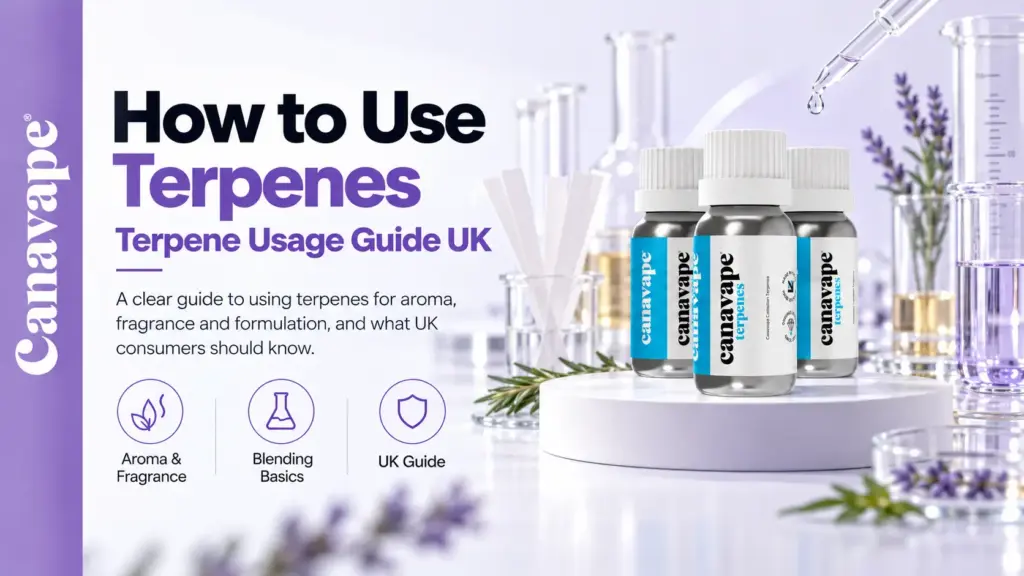
Prvním krokem k tomu, abyste se naučili, jak používat terpeny, je pochopit, co se vlastně v té lahvičce nachází.
Terpeny jsou koncentrované aromatické sloučeniny, které se vyskytují v celé rostlinné říši. Mezi známé příklady patří limonen z citrusových plodů, pinen z jehličnanů, myrcen z chmele a dalších rostlin, beta-karyofylen z černého pepře a linalool z levandule a koriandru.
Výrobci mohou tyto látky využívat k vytváření aromat, rekonstrukci rostlinných profilů, kompozici vůní a jako složku v produktech, jako jsou oleje do difuzérů, domácí vůně, svíčky, voskové taveniny a náležitě posouzené kosmetické nebo aromatické přípravky.
Pro ty, kteří hledají Terpeny Velká Británie, důležité je, že neexistuje žádný specifický britský typ terpenu. Tento výraz obvykle označuje osoby, které hledají terpenové složky, profily, dodavatele, možnosti použití a rady týkající se britského trhu.
Ve Velké Británii se mění regulační rámec, zamýšlené použití a druh dokumentace, která by měla být přiložena k profesionálním přísadám.
Koncentrované terpenové přípravky nejsou pouhé lahvičky s vůní připravenou k okamžitému použití. Lidé, kteří chtějí terpeny používat, si musí nejprve osvojit správný způsob jejich použití, než se o to pokusí.
Může se jednat o silné, vysoce těkavé chemické látky. Některé terpenové látky jsou hořlavé, dráždivé nebo senzibilizující. Některé mohou reagovat s určitými plasty. Jiné se při opakovaném vystavení vzduchu oxidují.
Správný způsob použití terpenů proto závisí na tom, co právě připravujete.
Koncentrace terpenů vhodná pro jeden vonný systém nelze automaticky použít u svíček, kosmetiky, potravin nebo jiných aplikací. Stejně tak by se nemělo předpokládat, že složka prodávaná pro laboratorní účely nebo pro přípravu vonných směsí je vhodná k požití, kůže aplikace nebo jiná cesta expozice.
Tato příručka vysvětluje, jak správně používat terpeny, v čem se liší terpenové profily a izoláty, jak je odměřovat a míchat, jaké nosné látky lze použít, jak sestavovat receptury aromatických produktů, jak skladování ovlivňuje terpeny a co by měli spotřebitelé a vývojáři, kteří se zajímají o společnost Terpenes UK, vědět před výběrem konkrétního použití.
Terpeny by se měly používat v souladu s určeným účelem použití a technickou dokumentací dodanou k dané složce. Nejprve si prostudujte specifikaci produktu, bezpečnostní list a informace o určeném použití.
Koncentrované terpeny se obvykle musí přidávat do vhodné směsi, nikoli používat v čisté formě. Vyberte si vhodný nosič nebo na základě složení produktu dodržujte doporučené dávkování pro danou aplikaci, odměřujte přesné množství, otestujte kompatibilitu na malé šarži a chraňte hotovou směs před zbytečným teplem, světlem a vzduchem.
Neexistuje žádné univerzální procento ředění terpenů, které by bylo vhodné pro všechny produkty, včetně těch, které lze najít na širším trhu společnosti Terpenes UK.
Hledaný výraz Terpeny Velká Británie může zahrnovat několik různých záměrů.
Někteří lidé mají zájem o nákup jednotlivých terpenových izolátů, jako je limonen, myrcen nebo beta-karyofylen.
Jiní zase hledají hotové terpenové profily inspirované ovocem, bylinami, květinami nebo odrůdami konopí.
Profesionální vývojáři receptur mohou zkoumat terpenové složky pro použití ve vůních, difuzérech, svíčkách, výrobcích z vosku, kosmetice nebo při laboratorním vývoji.
Ostatní uživatelé se možná jen snaží zjistit, zda terpeny jsou právní, bezpečné, přírodní nebo z konopí.
To znamená, že Terpeny Velká Británie Tuto kategorii je lepší chápat jako široký trh se surovinami a recepturami než jako trh s jedním konkrétním typem výrobku.
Než si cokoli koupíte, ujasněte si, k čemu vlastně potřebujete terpeny použít. Než budete pokračovat, zjistěte si, s čím máte co do činění a jak se terpeny vlastně používají.
Terpeny mají neobvykle široké spektrum využití, protože chemie vůní se uplatňuje v mnoha různých odvětvích.
V závislosti na konkrétní složce a jejích specifikacích lze terpenové sloučeniny a terpenové profily využít mimo jiné v následujících oblastech:
Klíčová věta zní: “v závislosti na konkrétní složce”.
Jedna lahvička terpenů by neměla být automaticky považována za vhodnou pro každé použití uvedené v tomto seznamu.
Při výběru z širší nabídky Terpeny Velká Británie trh, vycházejte spíše z účelu použití než pouze z vůně.
Profil pojmenovaný podle ovoce, botanické odrůdy nebo odrůdy konopí vám sice může napovědět, jakou vůni se snaží napodobit, ale automaticky vám neřekne:
Právě proto je dokumentace důležitá.
Profesionální složka by měla poskytovat podstatně více užitečných informací než jen název odrůdy a atraktivní etiketa.
Koncentrované terpenové složky by se obecně měly považovat spíše za suroviny pro výrobu přípravků než za spotřebitelské výrobky připravené k okamžitému použití.
Toto rozlišení je důležité.
Na stránkách zápach Vůně pomeranče je částečně způsobena limonenem.
To však neznamená, že by se s lahvičkou obsahující koncentrovaný limonen mělo zacházet stejně jako s pomerančovou kůrou.
Molekula se vyskytuje v radikálně odlišné koncentraci.
Z tohoto důvodu by první otázka neměla znít:
“Kolik kapek mám použít?”
Mělo by to být:
“K čemu se tento konkrétní terpenový produkt používá?”
Než začnete počítat procenta, určete, o jaký hotový výrobek se jedná.
Například:
Správná úroveň použití, nosič, posouzení bezpečnosti a označení se mohou v rámci těchto použití výrazně lišit.
Pokud začnete s hotovým přípravkem, předejdete jedné z nejčastějších chyb při sestavování receptury: použití obecného poměru ředění z internetu na zcela odlišnou kategorii výrobků.
Než začnete pracovat s terpenem izolovat nebo profil, prostudujte si dostupnou dokumentaci k danému materiálu.
Mezi užitečné informace mohou patřit:
To je obzvláště užitečné při srovnávání britských dodavatelů terpenů, protože dva produkty s podobným názvem odrůdy nebo vůně mohou mít velmi odlišné složení a zamýšlené použití.
SDS je bezpečnostní list.
Obsahuje bezpečnostní informace o chemické látce nebo směsi, které mohou zahrnovat:
Pokud pracujete s koncentrovanými terpenovými látkami, je bezpečnostní list (SDS) jedním z prvních dokumentů, které stojí za to si přečíst.
Analytický certifikát (COA) obvykle obsahuje analytické údaje týkající se daného výrobku nebo konkrétní šarže.
V závislosti na materiálu to může zahrnovat:
Bezpečnostní list (SDS) a certifikát pravosti (COA) nejsou zaměnitelné.
COA poskytuje informace o analytickém složení nebo kvalitě.
Bezpečnostní list (SDS) obsahuje informace o nebezpečích a bezpečném zacházení.
Terpeny lze zakoupit jako jednotlivé molekuly nebo jako předem sestavené profily.
Nejlepší volba závisí na cíli.
Terpenový izolát obsahuje jednu hlavní aromatickou molekulu.
Příklady zahrnují:
Izoláty se hodí v případech, kdy chce vývojář receptury mít přímou kontrolu nad jednotlivými složkami.
Terpenový profil obsahuje řadu sloučenin ve vybraných poměrech.
Profil může být:
Pro mnoho uživatelů je práce s hotovým profilem podstatně snazší než snaha rekonstruovat komplexní aroma z jednotlivých molekul.
| Funkce | Jednotlivý terpen | Terpenový profil |
|---|---|---|
| Složení | Jedna hlavní molekula | Řada aromatických sloučenin |
| Aroma | Relativně jednoduché | Vícevrstvé a komplexnější |
| Ovládání | Maximální kontrola nad jednou složkou | Profil je již vyvážený |
| Obtížnost formulace | K vytvoření komplexní vůně je zapotřebí větší zručnost | Často usnadňuje finální vývoj vůně |
| Typické použití | Stavební bloky a nastavení | Kompletní aromaterapie |
Při výběru se řiďte především vůní a zamýšleným konečným produktem, místo abyste vycházeli z předpokladu, že název profilu zaručuje konkrétní fyziologický účinek.
Užitečným způsobem, jak porovnávat profily, je rozdělení podle aromatických skupin.
Například:
To poskytuje měřitelný směr pro vývoj receptur, aniž by se spoléhalo na nepodložená tvrzení, jako například že určitý terpen slouží k spánek a další, který je určen pro zaměření.
Když lidé vyhledávají výraz „Terpenes UK“, často spíše porovnávají dodavatele, než aby se jen zajímali o chemii.
Na stránkách nejsilnější Dodavatel nemusí být nutně ten, který nabízí největší počet profilů nebo vzorky s nejvýraznější vůní.
Hledejte spíše užitečné technické informace.
Profesionální dodavatel terpenů ve Velké Británii by měl v ideálním případě umožnit pochopit:
Sledovatelnost a technické specifikace jsou užitečnější než vágní popisy, jako jsou „prémiová kvalita“, „farmaceutická kvalita“ nebo „ultrachristá“, pokud tyto výrazy nejsou podloženy měřitelnými údaji.
Botanické terpeny se získávají z rostlinných zdrojů jiných než konopí.
Lze je používat jednotlivě nebo je kombinovat do velmi podrobných terpenových profilů.
Jednou z výhod je opakovatelnost.
Vývojář receptury může určit jednotlivé složky a systematicky upravovat jejich poměry.
Botanické terpeny jsou obzvláště užitečné pro:
Botanické produkty tvoří významnou část trhu společnosti Terpenes UK, protože umožňují vytvářet velmi charakteristické vůně připomínající konopí, aniž by bylo nutné používat suroviny pocházející z konopí.
Podrobné srovnání zdrojů najdete na botanické terpeny vs. terpeny získané z konopí.
Terpeny pocházející z konopí, často zkráceně označované jako CDT, jsou aromatické frakce získávané přímo z rostlinného materiálu konopí.
Mohou poskytnout komplexní přirozený aromatický profil, nikoli pouhou napodobeninu založenou na rostlinných složkách, které nepocházejí z konopí.
Při práci s materiálem získaným z konopí mají obzvláštní význam zdrojová dokumentace a analýza kanabinoidů.
Samotné molekuly terpenů se liší od THC, avšak v závislosti na výrobním procesu může docházet k přenosu kanabinoidů.
Než si vyberete přísadu CDT, zkontrolujte:
Segment terpenů na britském trhu, který se specializuje na produkty odvozené z konopí, proto vyžaduje větší pozornost, pokud jde o původ a složení, než běžné rostlinné profily nepocházející z konopí.
Náš průvodce po zda jsou terpeny ve Velké Británii legální podrobně vysvětluje tento rozdíl.
Přesnost je důležitá, protože koncentrované aromatické složky mohou mít i v relativně malých množstvích silný smyslový účinek.
Při přípravě opakovaných receptur je vážení často spolehlivější než počítání kapek.
Laboratorní nebo výrobní pracovní postup může využívat:
Konkrétní vybavení by mělo být přizpůsobeno měřenému množství a chemické snášenlivosti dané složky.
Kapka není standardní měrnou jednotkou.
Velikost kapky se může měnit v závislosti na:
Dvacet kapek z jednoho dávkovače nemusí nutně obsahovat stejné množství látky jako dvacet kapek z jiného dávkovače.
Z tohoto důvodu není pokyn “použijte X kapek” vhodným základem pro přesné nebo opakovatelné namíchání přípravku.
Oba systémy lze používat v profesionální praxi, neměly by se však považovat za automaticky zaměnitelné.
Různé terpenové sloučeniny a směsi mají různou hustotu.
Jeden mililitr nemusí nutně odpovídat jednomu gramu.
Pokud je receptura vypracována na základě hmotnosti, pokračujte v používání hmotnosti jako jednotky měření, dokud nebude správně zohledněna hustota.
U povolené formulace, u níž již byla stanovena příslušná hladina obsahu, lze hmotnostní koncentraci vypočítat podle následujícího vzorce:
Tento vzorec slouží pouze k výpočtu koncentrace.
Neuvádí, jaké procento je pro konkrétní použití bezpečné nebo vhodné.
To musí vyplývat z technické specifikace, příslušných norem a posouzení hotového výrobku.
Neexistuje žádný univerzální poměr ředění terpenů.
Toto je možná nejdůležitější praktický bod v tomto průvodci.
Vhodná míra začlenění se může lišit v závislosti na:
Procentní podíl použitý v parfémovém koncentrátu by neměl být automaticky přenesen do receptury kosmetického přípravku, difuzéru nebo potraviny.
Bezpečný postup závisí spíše na konkrétní aplikaci než na nějakém univerzálním receptu.
Tento postup je sice pomalejší než zkopírování poměru z internetu, je však podstatně spolehlivější.
To záleží na terpenovém profilu a způsobu použití.
Mnohé terpeny jsou lipofilní, což znamená, že mají větší afinitu k olejům a jiným nepolárním látkám než k vodě.
Mohou být také rozpustné v různých organických rozpouštědlech používaných v parfémářství.
Vývojář receptur se proto může setkat s terpenovými systémy, které zahrnují:
Kompatibilitu je třeba u hotové aplikace ověřit, a ne ji pouze předpokládat.
Mnohé běžné terpeny se ve vodě špatně rozpouštějí.
Již pouhé přidání koncentrovaných terpenů do vody může mít za následek:
Hotový výrobek na vodní bázi může vyžadovat vhodný systém pro solubilizaci nebo emulgaci.
Jedná se spíše o chemické složení než o pouhé přidání většího množství vody.
Mnohé terpenové sloučeniny vykazují díky své hydrofobní povaze dobrou kompatibilitu s vhodnými materiály na bázi lipidů.
To však neznamená, že každý olej je vhodný pro každý zamýšlený výrobek.
Nosič je třeba vybrat s ohledem na konkrétní použití, požadavky na stabilitu a právní rámec.
Do parfémových systémů na bázi alkoholu lze začlenit mnoho terpenů a vonných látek.
Kompatibilita závisí na přesném složení, alkohol koncentrace, obsah vody a další složky.
Přípravky na bázi alkoholu s sebou přinášejí také otázky týkající se hořlavosti, které je třeba zohlednit při navrhování výrobku i při manipulaci s ním.
Jedno z nejvýznamnějších možných využití pro širší Terpeny Velká Británie Trh se zaměřuje na vývoj aromat a vůní.
Terpeny poskytují vývojářům receptur širokou škálu rozpoznatelných rostlinných tónů.
Limonen může přispět k citrusovému charakteru.
Pinen může vnést svěží pryskyřičné tóny.
Beta-karyofylen může dodat pepřovou a dřevitou hloubku.
Linalool může dodávat květinové tóny.
Myrcen může dodávat zemitou a bylinnou chuť.
Díky kombinaci těchto surovin mohou tvůrci parfémů jít daleko za hranice jednoduchých jednozložkových vůní.
Terpeny mohou sloužit jako základní stavební kameny ve složení vůní.
Mohou přidávat poznámky, jako například:
Jednotlivé izoláty lze použít k doladění konkrétní tóny, zatímco ucelené terpenové profily mohou tvořit ústřední aromatické téma vůně.
Hotová vůně ještě musí projít vývojem pro své skutečné konečné použití.
Použití parfému na pokožku představuje jiný scénář expozice než v případě pokojové vůně nebo svíčky.
Užitečným postupem při vývoji je začít spíše s cílovou vůní než s názvy jednotlivých složek.
Například určete, zda chcete, aby profil byl:
Poté si můžete vybrat existující terpenový profil, který tomuto směru odpovídá, nebo vytvořit směs z jednotlivých složek.
Senzorické hodnocení by mělo probíhat pod kontrolou, nikoli opakovaným čicháním ke koncentrované látce přímo z lahvičky.
Při profesionálním hodnocení vůní se obvykle používají vonné kartičky nebo jiné kontrolované metody, aby se zjistilo, jak se vůně v průběhu času vyvíjí.
Díky tomu je snazší provést srovnání:
Dodržujte bezpečnostní pokyny pro manipulaci s danou složkou a v případě potřeby zajistěte dostatečné větrání.
Difuzéry s rákosovými tyčinkami představují obzvláště zajímavé využití pro Terpeny Velká Británie protože umožňují prezentovat komplexní botanické a konopím inspirované vůně, aniž by bylo nutné spoléhat se na spalování.
Terpenové profily lze začlenit do profesionálně namíchaných olejů do difuzérů, pokud je celkový vonný systém i nosná látka vhodné.
Terpenové profily lze použít jako aromatické složky v profesionálně namíchaných olejích do difuzérů s rákosovými tyčinkami.
Důležité je, že koncentrované terpeny ještě neznamenají hotový olej do difuzéru.
Receptura difuzéru obvykle vyžaduje vhodný základ, který musí být schopen:
Terpenová složka se pak stává součástí této kompletní receptury.
Použití koncentrovaného terpenového profilu v neředěné formě není totéž jako použití správně namíchaného oleje do difuzéru.
Látka se může odpařovat příliš rychle, může se při styku s jazýčky chovat nepředvídatelně, může být zařazena do vyšší třídy chemického nebezpečí nebo může reagovat s obalem.
Použijte přípravek speciálně určený pro použití v difuzérech.
Nosič musí být vhodný pro difúzi pomocí tyčinek a musí být chemicky kompatibilní s vonným systémem.
Výběr může záviset na:
Právě proto je lepší zvolit profesionálně navrženou základnu difuzéru než libovolný olej jen proto, že je tekutý.
V ultrazvukovém difuzéru používejte aromatický přípravek pouze tehdy, je-li určený pro toto zařízení nebo pro něj vyvinutý.
Mnohé koncentrované terpenové látky jsou ve vodě špatně rozpustné.
Jejich přímé přidání do vody může způsobit oddělování složek a nemusí být vhodné pro dané zařízení nebo scénář expozice.
Řiďte se pokyny výrobce difuzéru a určeným způsobem použití aromatického přípravku.
Další, který se vyvíjí Terpeny Velká Británie Tato řada zahrnuje vonné produkty pro domácnost, zejména svíčky a voskové taveniny.
Chemické složení terpenů dokáže vytvořit charakteristické rostlinné tóny, které se liší od běžných sladkých nebo parfémových vonných olejů.
Přítomnost tepla však znamená, že chování terpenového profilu v lahvi se může podstatně lišit od jeho chování ve vosku.
Vůně obsahující terpeny mohou svíčkám dodat charakteristické aromatické tóny.
Složení svíčky s sebou přináší několik dalších proměnných:
Terpenový profil by proto měl být posuzován jako součást celkového systému vůně svíčky, a nikoli přidáván podle univerzálního procentuálního podílu.
Ano, do správně navržených systémů pro provonění pomocí roztaveného vosku lze přidat vhodné aromatické složky.
Stejně jako u svíček by míra použití měla zohledňovat kompletní složení vůně, voskovou směs a příslušné posouzení bezpečnosti.
Teplo může také ovlivnit těkavé aromatické sloučeniny, takže vůně, která z lahvičky voní skvěle, se může chovat jinak, jakmile se smíchá s ohřátým voskem.
Během výroby nebo používání může dojít ke ztrátě některých těkavých látek, zejména u lehčích monoterpenů.
Různé terpeny se vyznačují odlišnou těkavostí a tepelnou stabilitou.
To znamená, že působení tepla může narušit rovnováhu komplexního profilu.
Náš průvodce po teploty odpařování, hoření a rozkladu terpenů vysvětluje, proč samotná teplota varu nedokáže předpovědět vše, co se stane při zahřátí terpenu.
Kosmetika je další oblastí, kde Terpeny Velká Británie tento výzkum se překrývá s konvenční chemickou vědou v oblasti parfémů.
Mnohé sloučeniny, o nichž se běžně hovoří jako o terpenech konopí, jsou již dobře známé jako složky kosmetických přípravků a parfémů.
Důležitým rozdílem je, že kosmetický přípravek se posuzuje jako ucelená hotová formulace.
Vonné složky obsahující terpeny mohou dodávat vůni mýdlovým přípravkům, pokud jsou tyto složky vhodné pro kosmetické použití.
Chemie mýdla však může být náročná.
Proměnné, jako například:
může ovlivnit jak vůni, tak bezpečnostní aspekty konečného výrobku.
Komerční kosmetické mýdlo je třeba posuzovat jako hotový kosmetický přípravek, nikoli jako izolovanou složku terpenu.
Terpeny a vonné látky obsahující terpeny se v kosmetice vyskytují velmi často.
Mezi příklady patří například:
U výrobku uváděného na trh ve Velké Británii se předpisy pro kosmetické přípravky vztahují na kompletní hotovou formulaci.
To zahrnuje posouzení bezpečnosti před uvedením kosmetického přípravku na trh.
Nepředpokládejte, že jen proto, že se terpen přirozeně vyskytuje v levanduli, citrusových plodech nebo jiné rostlině, lze jej nanášet na pokožku v neředěné formě. Koncentrované terpenové látky mohou pokožku dráždit nebo přispívat k její senzibilizaci a oxidované vonné sloučeniny mohou mít jiné alergenní vlastnosti než čerstvý materiál.
Koncentrované terpenové složky by neměly být automaticky považovány za topické přípravky připravené k okamžitému použití.
Many require controlled formulation and safety assessment.
Some can irritate the skin, while compounds such as limonene and linalool can form oxidation products relevant to contact allergy.
Podrobné vysvětlení najdete v článku Jsou terpeny bezpečné?
Searches for Terpeny Velká Británie also sometimes come from people interested in food and flavour chemistry.
This area requires particular care because a compound existing naturally in food is not the same thing as every commercial bottle containing that compound being suitable for consumption.
Ingredient specification and authorisation matter.
Terpenes are important in food aroma and flavour chemistry.
However, a terpene product should only be used in food where the substance and supplied ingredient are suitable and permitted for that food application.
In Great Britain, the Food Standards Agency maintains an official register of authorised flavouring substances and their conditions of use.
The fact that a terpene occurs naturally in food does not automatically mean any concentrated product containing that terpene is sold for consumption.
This question needs to distinguish between a chemical occurring naturally in food and a concentrated commercial ingredient.
Limonene occurs naturally in citrus fruit.
Beta-caryophyllene occurs naturally in black pepper.
That does not mean an aroma-grade or laboratory terpene product should be swallowed.
Only use a product in food if it is specifically supplied for the relevant food application and meets the applicable requirements.
Ne.
Terpenes can be supplied for different industrial and formulation purposes.
A laboratory, fragrance or aroma ingredient should not be assumed suitable for food.
For food use, check:
Terpene-rich botanical aromas are closely related to the chemistry encountered in essential oils and fragrance products.
If a product is intended for room aroma or another aromatherapy-style application, use it according to that finished product’s instructions.
Do not assume that a concentrated raw terpene ingredient is interchangeable with a consumer-ready essential oil or diffuser blend.
An essential oil is normally a complex natural extract containing numerous volatile compounds.
A terpene isolate can contain one principal molecule.
A formulated terpene profile sits somewhere between those concepts because multiple defined ingredients can be deliberately combined.
| Materiál | Složení | Hlavní výhoda |
|---|---|---|
| Terpene isolate | One principal compound | Precise control |
| Terpenový profil | Defined blend of aromatic compounds | Repeatable complex aroma |
| Esenciální olej | Natural botanical volatile extract | Native botanical complexity |
Ano.
Many of the major terpenes found in cannabis occur naturally in other plants.
This allows botanical terpenes to be combined into cannabis-inspired profiles without the blend necessarily containing cannabis-derived ingredients.
Examples of aroma families that can be recreated include:
Modern cannabis aroma research also suggests that trace non-terpene volatile compounds can contribute significantly to authentic cultivar aroma, meaning the most detailed profiles can involve more than just a handful of major terpenes.
Custom blending is easiest when approached systematically.
Rather than changing multiple ingredients at once:
Keeping accurate formulation records is important.
Without records, a successful profile can be surprisingly difficult to reproduce.
A freshly mixed fragrance profile can smell different after its components have had time to equilibrate within the formulation.
This is sometimes referred to informally as resting or maturation.
It should not be described as molecules “bonding together” unless an actual chemical reaction is intended.
In many cases, the mixture is simply becoming more homogeneous and the sensory balance becomes easier to judge.
Homogenisation means creating an even distribution of ingredients throughout a formulation.
The appropriate mixing method depends on:
A low-viscosity fragrance mixture and a wax formulation may need completely different processing approaches.
Do not add heat simply because a terpene needs to be mixed.
Many terpenes are volatile, and unnecessary heating can increase evaporative loss or accelerate chemical change.
If the manufacturing process requires heat, such as wax production, the temperature exposure should be considered as part of the formulation process.
There is no universal terpene use temperature.
Different applications involve completely different conditions.
It is also incorrect to assume that a terpene must reach its normal boiling point before it evaporates.
Terpenes have measurable vapour tlak below their boiling temperatures and can be lost progressively from formulations over time.
Three factors are particularly important:
These principles apply during both formulation and storage.
Terpenes are volatile molecules.
That volatility is exactly why the nose can detect them.
Molecules leave the liquid or solid matrix and enter the surrounding air, where they reach olfactory receptors.
The downside is that an open container can gradually lose its lighter components.
Many monoterpenes are relatively volatile compared with heavier sesquiterpenes.
This is a useful generalisation rather than an absolute rule for every compound.
Examples of common monoterpenes include:
Beta-caryophyllene and humulene are examples of heavier sesquiterpenes.
This difference can cause an ageing profile to change balance rather than simply becoming uniformly weaker.
Storage is particularly relevant when buying concentrated Terpeny Velká Británie products because these materials are often supplied in small containers that may be opened repeatedly during formulation.
Each opening replaces some of the protected headspace with fresh air and can increase oxygen exposure.
Temperature fluctuations and light exposure can also accelerate changes in sensitive aromatic ingredients.
Follow the storage instructions supplied for the specific product.
General considerations include:
Storage is important not only for maintaining aroma but also for limiting oxidation.
Viz . jak skladovat a uchovávat terpeny for our dedicated guide.
Terpenes can react with oxygen.
Oxidation can:
Limonene and linalool are particularly useful examples because their oxidation products are well known within fragrance allergy research.
There is no universal shelf life applying to every terpene product.
Stabilita závisí na:
Use the shelf-life or retest information supplied for the specific product rather than assuming every terpene lasts the same number of months.
Packaging compatibility matters.
Some concentrated terpenes can interact with particular plastics, seals and elastomers.
Glass is commonly used for concentrated aromatic ingredients because of its broad chemical resistance, although closures and seals also need to be compatible.
The correct material should follow the product specification and application.
Někteří to dokážou.
Concentrated limonene, for example, has useful solvent properties.
This does not mean every terpene dissolves every plastic, but it does mean material compatibility should not be assumed.
Test the actual packaging system before committing to a finished product.
Some aromatic chemicals can cause particular elastomers to swell, soften or lose performance.
This is another reason to test bottles, caps, seals and dispensing components using the actual formulation rather than judging compatibility from appearance.
Products found through Terpeny Velká Británie searches range from low-concentration finished aroma products to highly concentrated raw ingredients.
Those are not equivalent exposure scenarios.
A concentrated terpene profile should be treated according to its actual safety information rather than assuming the word natural makes it harmless.
Use the precautions stated in the product’s SDS.
Depending on classification, appropriate controls can include:
Not every terpene carries exactly the same classification, so the individual SDS matters.
Terpene aroma is encountered naturally throughout the environment, but directly inhaling repeatedly from a bottle of concentrated material is not the same exposure as smelling a plant.
Use concentrated aroma ingredients in a well-managed environment according to their safety information.
If an ingredient causes irritation or discomfort, discontinue exposure.
A terpene being acceptable for food, fragrance or another application does not automatically establish its suitability for concentrated inhalation.
Exposure routes have different toxicological considerations.
Only use a product according to the purpose for which it has been specifically formulated, assessed and supplied.
This is why descriptions such as natural or food grade should never be interpreted as universal approval for every exposure route.
A concentrated raw terpene ingredient should generally be thought of as a formulation ingredient.
Whether it is ready for direct consumer use depends entirely on what the supplier has actually manufactured and labelled it for.
If the bottle is a concentrated ingredient, follow its intended-use instructions rather than improvising a new application.
There is no universal answer, and counting drops is not a reliable formulation method.
The correct amount depends on the:
Professional formulation is better expressed as a defined mass percentage or other accurately measured concentration.
Ano.
More terpene does not necessarily mean better aroma.
Excessive concentrations can:
Good terpene formulation is about balance rather than maximum concentration.
Human smell is extremely sensitive to some volatile compounds.
A small amount of a potent aromatic molecule can dramatically change an entire profile.
Increasing every component simply makes the mixture stronger rather than necessarily making it more accurate, sophisticated or pleasant.
For development work, it is usually better to return to the formulation record and adjust the profile systematically rather than adding random ingredients to disguise the problem.
Mezi užitečné otázky patří:
Controlled reformulation creates much more useful information than trial and error without records.
The appropriate stability period depends on the finished product.
At minimum, formulation development should consider whether the product changes after initial mixing.
Commercial products may require a more structured stability programme examining factors such as:
A formulation that looks stable after one hour may behave differently after weeks or months.
Terpene profiles can have a strong impact at relatively low quantities.
Small development batches make it easier to:
Once a formulation performs correctly, it can then be scaled using the documented proportions.
Scaling should preserve the formulation percentages rather than simply multiplying approximate drop counts.
This is another advantage of developing by mass.
For example, if a finished formulation has been established as a percentage-by-mass recipe, the same relative percentages can be used when increasing total batch size.
Production equipment, mixing efficiency and heat transfer can still change at larger scale, so scale-up should be verified rather than assumed to be perfect automatically.
A basic formulation record can include:
Accurate records turn aroma development into a repeatable process rather than a one-off experiment.
Professional use is essentially the same process performed with more control.
The formulator defines:
Only then does the terpene become one component within a complete finished product.
Ne.
Terpene molecules can be extracted from botanical sources or manufactured using other processes.
If two molecules have the same structure and stereochemistry, their molecular identity does not change simply because one came from a plant.
What can differ is:
Natural should therefore describe origin rather than be used as a synonym for safe or superior.
Ne.
A sophisticated botanical formulation can closely reproduce many cannabis-associated aromatic characteristics because most major cannabis terpenes occur elsewhere in nature.
Cannabis-derived fractions can nevertheless offer native complexity, particularly through minor components present alongside the dominant terpenes.
The appropriate choice depends on the formulation objective.
Terpene descriptions can focus on objectively defensible characteristics such as:
Statements such as “high in limonene” and “bright citrus aroma” describe the material.
Statements promising sleep, pain relief, úzkost reduction or another therapeutic outcome enter a very different evidential and regulatory territory.
Terpenes are not necessarily biologically inactive.
Individual compounds are investigated across numerous areas of pharmacology.
Beta-caryophyllene, for example, has recognised activity at CB2 receptors.
That does not mean every commercial terpene profile has a predictable therapeutic effect.
For a detailed evidence review, see how do terpenes affect the body?
No. Common terpene compounds do not independently produce the characteristic cannabis intoxication associated with THC.
This is true whether the terpene is obtained from citrus, hops, lavender, cannabis or another plant.
Přečtěte si Způsobují terpeny opojení? for the full scientific explanation.
People searching for Terpeny Velká Británie frequently want to know whether purchasing or using terpene ingredients is legal.
Common terpene molecules are generally legal in the UK and are not controlled drugs simply because the same compounds occur naturally in cannabis.
The main additional legal consideration arises where the ingredient itself is derived directly from cannabis.
Common terpene molecules are generally legal in the UK.
Botanical terpenes obtained from ordinary non-cannabis plants have a relatively straightforward controlled-drug position.
Cannabis-derived terpene materials require more attention because the starting material is cannabis and the aromatic fraction can potentially contain controlled cannabinoids depending on processing.
The UK 0.2% figure is not a general finished-product THC allowance, and the 1 mg exempt-product provision is more complex than a single numerical threshold.
Přečtěte si are terpenes legal in the UK? for the complete legal guide.
The intended finished product determines which regulatory framework may apply.
| Aplikace | Key Consideration |
|---|---|
| Raw terpene ingredient | Chemical classification, handling and supplier documentation |
| Home fragrance | Finished mixture safety, classification and appropriate labelling |
| Candle or wax product | Fragrance suitability and finished-product safety |
| Cosmetic | Finished cosmetic safety assessment and cosmetics requirements |
| Food flavouring | Ingredient authorisation, specification and conditions of use |
| Cannabis-derived ingredient | Controlled-cannabinoid composition and lawful source |
Before purchasing from a Terpeny Velká Británie source, the following checklist can help distinguish a professional formulation ingredient from a poorly documented aroma product.
This type of information is particularly valuable because the Terpeny Velká Británie search landscape contains everything from professional aromatic raw materials to consumer products and poorly specified imports.
A few principles prevent many common mistakes.
Look beyond the strain name or packaging.
Useful information includes:
A serious formulation ingredient should come with enough information to understand what you are working with.
Choose according to the objective rather than assuming one category is always superior.
Read our complete comparison of botanical and cannabis-derived terpenes before choosing.
A complex terpene mixture is not perfectly static.
Over time:
This means a badly stored profile can drift away from the formula originally produced.
When a terpene profile is used commercially, repeatability becomes important.
A customer purchasing the same aromatic profile months later reasonably expects a recognisable result.
This is easier to achieve when:
Several frequently encountered terpene and terpenoid ingredients.
| Složené | Typická vůně | Běžné botanické zdroje |
|---|---|---|
| Myrcen | Zemitá, bylinná, pižmová | chmel, citronová tráva, bobkový list |
| Limonen | Citrusy, citron, pomeranč | Citrusová kůra |
| Alfa-pinen | Borovice, svěží, pryskyřičná | Jehličnany, rozmarýn |
| Beta-karyofylen | Pepřová, kořeněná, dřevitá | Černý pepř, hřebíček |
| Humulene | Woody, earthy, hoppy | Chmel |
| Terpinolen | Svěží, bylinná, květinová | Četné aromatické rostliny |
| Linalool | Květinová, připomínající levanduli | Levandule, koriandr |
For the wider classification, read různé druhy terpenů.
Terpenes occur throughout nature.
The same compounds associated with cannabis can also occur in:
Přečtěte si Kde se vyskytují terpeny? for our complete guide to botanical sources.
Terpene ingredients can be obtained through several processes depending on the source and target material.
Mezi ně mohou patřit:
The production method can influence the complexity and impurity profile of the resulting ingredient.
Přečtěte si Jak se terpeny vyrábějí a extrahují? podrobný návod.
Drop size varies. Use a defined measurement system for repeatable formulations.
Products can range from individual isolates to complex diluted profiles.
Different applications require different safety and formulation assessments.
Natural origin does not eliminate concentration-dependent hazards.
Some concentrated terpene materials can interact with plastics and seals.
Volatile loss and oxidation can alter the profile.
Food suitability does not automatically establish cosmetic or inhalation suitability.
Heat can accelerate volatile loss and chemical degradation.
A balanced profile can outperform an excessively concentrated one.
Source, safety and composition information matter when using concentrated ingredients.
If this guide has introduced you to practical terpene formulation, the wider knowledge hub explores the chemistry behind each stage.
Přečtěte si jaké jsou účinky terpenů for their wider role in nature, různé druhy terpenů for chemical classification, kde se vyskytují terpeny for botanical sources and jak se terpeny vyrábějí a extrahují for production methods.
For sourcing and formulation decisions, compare botanické terpeny vs. terpeny získané z konopí and learn what live resin terpenes are.
For handling and product development, read Jsou terpeny bezpečné?, are terpenes legal in the UK?, jak skladovat a uchovávat terpeny a teploty odpařování a rozkladu terpenů.
Together, these pages create a detailed resource for anyone researching Terpeny Velká Británie, whether the objective is understanding the chemistry, choosing a supplier, comparing botanical and cannabis-derived materials or developing a finished aroma formulation.
Můžete si také prohlédnout kompletní Kolekce terpenů Canavape a náš odborník profily terpenů získaných z konopí.
Use terpenes as formulation ingredients according to the intended application and supplier documentation. Choose a compatible product base, follow an application-specific inclusion level, measure accurately, make a small test batch and protect the finished formulation from unnecessary heat, air and light.
Terpenes UK is generally a search phrase used by people looking for terpene products, suppliers, information and formulation guidance relevant to the UK. It does not describe a separate chemical type of terpene.
Terpene ingredients and profiles are available from specialist UK suppliers. Look for clear source information, batch traceability, appropriate technical documentation, storage guidance and a clearly stated intended use rather than choosing purely by strain name or aroma.
A concentrated terpene bottle should normally be treated as a formulation ingredient unless the supplier specifically states that it is a ready-to-use finished product. Do not assume concentrated material is intended for direct use.
Concentrated terpene ingredients commonly need to be incorporated into a suitable formulation. The correct concentration depends on the specific chemical, product category and intended use rather than one universal dilution ratio.
There is no universal ratio. Use an inclusion level suitable for the actual terpene material and finished application, based on supplier documentation and the relevant finished-product assessment.
Drop counting is not a reliable formulation method because drop size varies between dispensers and liquids. Repeatable formulations are better measured using a defined mass or volume appropriate to the formulation.
Both can be used, but mass is often convenient for repeatable formulation. Volume and mass are not automatically interchangeable because terpene blends can have different densities.
Many common terpene compounds have poor water solubility. Simply adding them to water can produce separation or floating droplets, so water-based products may require an appropriate formulation system.
Many terpene compounds are lipophilic and can be compatible with suitable oils, but the carrier must still be appropriate for the intended finished product.
Many terpene and fragrance compounds can be incorporated into appropriate alcohol-based fragrance systems. The complete formulation, water content and flammability still need to be considered.
Terpene profiles can form part of a properly formulated reed diffuser oil. Concentrated terpenes are not automatically a finished diffuser product and should be incorporated into a suitable diffuser base according to the formulation specification.
A concentrated terpene ingredient should not automatically be treated as ready-to-use diffuser oil. Neat material may evaporate too quickly, behave poorly with reeds or have different hazard and packaging requirements.
Only use an aromatic product in an ultrasonic diffuser when it is supplied or formulated for that device. Many terpenes are poorly soluble in water, and concentrated ingredients should not simply be added to water without suitable formulation.
Suitable terpene-containing fragrance profiles can be incorporated into candle formulations, but wax compatibility, fragrance concentration, wick performance and thermal behaviour all need to be assessed within the finished candle.
Suitable fragrance ingredients can be used within properly formulated wax melts. The complete fragrance system and wax should be tested together rather than applying a universal terpene percentage.
Terpene-containing fragrance materials can be used in suitable cosmetic soap formulations, but the complete finished cosmetic needs to be assessed for safety and compliance.
Yes, terpene and fragrance compounds are widely used in cosmetics. A commercial finished cosmetic in Great Britain must undergo the appropriate finished-product safety assessment and meet cosmetic requirements.
Concentrated raw terpenes should not automatically be treated as ready-to-use topical products. Some can irritate or sensitise skin and should only be used in appropriately designed and assessed formulations.
Yes. Individual terpenes and terpene profiles can act as aromatic building blocks within fragrance compositions, subject to the safety requirements of the finished perfume.
Some individual terpene substances are authorised for particular food-flavouring uses. Only use an ingredient in food when it is specifically suitable for food use and complies with the applicable authorisation and conditions.
Do not assume a concentrated terpene product is intended for ingestion simply because the same molecule occurs naturally in food. Use only products specifically supplied and compliant for the relevant food application.
No. Terpene ingredients can be supplied for fragrance, laboratory, aroma, industrial and other uses. Product specifications and intended use matter.
A terpene being suitable for food or fragrance does not automatically establish concentrated inhalation safety. Only use a product according to the exposure route and purpose for which it has been specifically formulated and assessed.
The same individual molecule can be chemically identical regardless of plant source, but complete profiles differ. Botanical profiles are formulated from non-cannabis ingredients, while cannabis-derived terpenes are obtained directly from cannabis and can contain a more complex native volatile mixture.
Use cannabis-derived terpenes according to the supplier’s intended application and technical specification. Because cannabis is the source material, cannabinoid analysis and traceability are particularly important.
Botanical terpenes can be used individually as fragrance building blocks or as completed profiles within suitable formulations. The correct carrier and inclusion level depend on the finished product.
Yes. Many dominant cannabis terpenes also occur naturally in other plants, allowing botanical ingredients to be combined into convincing cannabis-inspired aroma profiles.
Terpene profiles can be blended during controlled formulation work, but doing so creates a new mixture whose aroma, concentration and potentially its safety classification need to be considered.
Yes. Individual isolates can be combined to develop original aromatic profiles. Accurate measurement and formulation records are important if you want the blend to be repeatable.
A freshly mixed aroma can change as the formulation becomes homogeneous and equilibrates. Allowing a development sample to settle before final sensory evaluation can therefore be useful, although this should not be described as the terpenes chemically bonding unless a reaction actually occurs.
Avoid unnecessary heat because many terpenes are volatile. Where heating is required by the product process, such as wax formulation, temperature exposure should be controlled and considered during product development.
Yes. Their volatility is what allows terpene molecules to reach the nose and create aroma. Heat, airflow and open containers can accelerate volatile loss.
Follow the individual supplier specification. In general, concentrated terpenes benefit from tightly sealed compatible packaging and protection from unnecessary heat, light and oxygen exposure.
Terpene profiles can change over time through evaporation and oxidation. There is no universal shelf life, so use the storage and shelf-life information supplied with the particular product.
Some concentrated terpene materials can interact with particular plastics and elastomers. Packaging compatibility should therefore be tested for the actual formulation.
Safety depends on the specific compound, concentration, formulation, route of exposure and condition of the material. Natural origin alone does not make concentrated terpenes harmless.
Common terpene molecules are generally legal in the UK. Cannabis-derived ingredients require additional consideration because of the controlled cannabis source and possible cannabinoid carryover.
No. Common terpene compounds do not independently create the characteristic intoxicating high associated with THC.
No. Higher concentration can overpower a fragrance, increase irritation potential or change the properties of a finished product. Good formulation focuses on balance rather than maximum strength.
A COA can provide useful analytical and batch information, particularly for professional formulation. For cannabis-derived materials, cannabinoid analysis can be especially relevant.
The SDS communicates hazards and safe handling information. The COA provides analytical information relating to the product or batch. They answer different questions.
The most important lesson in learning how to use terpenes is that there is no single universal way to use them.
Terpenes are ingredients.
How they should be handled depends on what you intend to make.
A terpene used within a perfume, reed diffuser, candle, cosmetic or authorised food flavouring application enters a different formulation environment each time.
The concentration, carrier, packaging, exposure route and safety requirements can all change.
This is why the best starting point is not a generic number of drops or an internet dilution ratio.
Start with the finished product.
Then establish:
Measure accurately rather than relying on drops.
Develop small test batches before scaling.
Record every formulation.
Avoid unnecessary heat and prolonged air exposure.
Do not assume a natural ingredient is harmless when concentrated.
Do not assume a product appropriate for one exposure route is automatically appropriate for another.
And when working with cannabis-derived terpenes, confirm the cannabinoid composition rather than relying on the product name.
For anyone researching Terpeny Velká Británie, this is the most useful way to think about the market: not as one single product category, but as a broad family of aromatic ingredients that can be selected and formulated according to source, composition and intended application.
Used this way, terpenes become much more than a strong-smelling bottle.
They become precise aromatic building blocks that can be selected, measured and combined to create repeatable botanical profiles across fragrance, home aroma and other appropriately assessed formulations.
Další informace najdete zde Jsou terpeny bezpečné?, are terpenes legal in the UK?, různé druhy terpenů, kde se vyskytují terpeny, jak se terpeny vyrábějí a extrahují, jak skladovat a uchovávat terpeny, teploty odpařování a rozkladu terpenů, botanické terpeny vs. terpeny získané z konopí a Co jsou to terpeny v konopí a marihuaně?.
You can browse our terpenové profily and specialist terpeny pocházející z konopí to compare different aromatic approaches available within the UK.
This guide provides general educational information about terpene handling and formulation. It is not a substitute for the Safety Data Sheet, supplier specification, application-specific safety assessment or professional regulatory advice. Always use a terpene ingredient only for applications for which it is suitable and appropriately assessed.

Napište nám přímo
Brzy se vrátím

