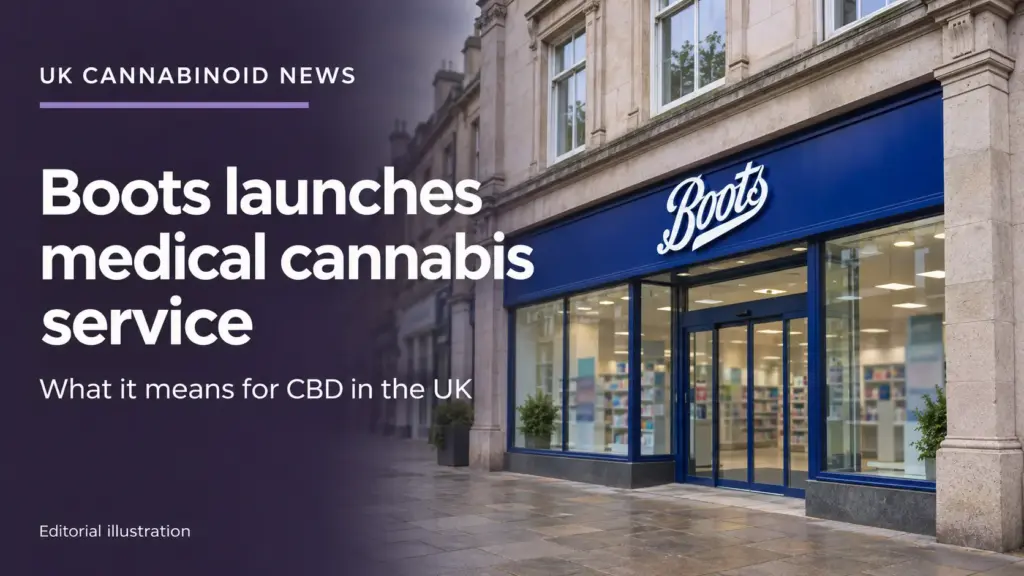
Boots has launched a private medical cannabis service through Boots Online Doctor, giving eligible patients access to specialist assessment and, where clinically appropriate, a prescription for medical cannabis.
The service, called SureLeaf, is intended for adults aged 25 and over who have certain long-term conditions and have not experienced adequate relief from conventional treatments. These include eligible chronic pain conditions, generalised anxiety disorder and insomnia.
For anyone who has followed the UK cannabis and CBD sector over the last decade, this is a significant moment. A household name associated with the British high street is now offering a specialist service involving cannabis-based medicines.
But what does the announcement mean in practice? Can you walk into a Boots pharmacy and buy cannabis? Does medical cannabis always contain THC? And how does a prescription medicine compare with the CBD products available from companies such as Canavape?
Here, we explain what Boots has announced, what it could mean for the wider conversation around cannabinoids, and why the distinction between prescribed medicines and consumer CBD products matters.
Boots announced the launch of SureLeaf on 16 November 2026. According to its announcement and service information:
Having an eligible condition does not automatically mean someone will receive a prescription. The clinical team must decide whether treatment is appropriate for the individual. Read the official Boots launch announcement for the original statement.
SureLeaf is a specialist medical cannabis service from Boots Online Doctor. It brings together online assessment, consultations with specialist doctors and ongoing care for patients who are accepted for treatment.
Boots says the service is designed for people living with eligible long-term conditions where conventional treatments have not provided sufficient symptom relief.
The process starts with an online assessment. Where appropriate, patients then have a video consultation with a consultant who is listed on the General Medical Council’s Specialist Register and works in the relevant medical specialty.
A proposed prescription is subject to an additional clinical review before treatment begins. Boots also says patients will have an initial review after 28 days, followed by reviews at least every three months.
This is a healthcare service involving an individual clinical decision. It is not a general retail launch of cannabis products.
No. The service announced by Boots is a private, specialist-led service that starts online. A patient must be assessed, and a prescription is only considered where the clinician decides it is appropriate.
The presence of the Boots name does not mean a customer can walk into a high-street branch and buy medical cannabis over the counter. The SureLeaf service page describes treatment being dispensed and discreetly delivered to the patient’s door.
That distinction matters because some headlines may give the impression that cannabis is now on pharmacy shelves alongside ordinary retail products. The announcement is about access to a clinical service and, for eligible patients, the possibility of prescribed treatment.
Boots says SureLeaf is for eligible patients aged 25 or over who have certain long-term conditions and have previously tried conventional treatments without adequate symptom relief.
The conditions listed by Boots include:
Its chronic pain list includes examples such as fibromyalgia, chronic back or neck pain, neuropathic pain, osteoarthritis, rheumatoid arthritis, chronic migraine and endometriosis-related pelvic pain.
However, being diagnosed with one of these conditions is only part of the picture. Previous treatment, medical history and the specialist’s assessment all matter.
If you are considering the service, check the current SureLeaf information and eligibility details directly with Boots and discuss questions about your health and treatment with a qualified clinician.
No. Boots says medical cannabis is not appropriate for everyone, and prescribing decisions are made on an individual basis.
A specialist will need to consider your medical history, previous treatments and whether a cannabis-based medicine is clinically appropriate. A further clinical review takes place before any proposed prescription begins.
This is particularly important because a list of conditions can easily be mistaken for a promise of treatment. The list describes who may be considered for assessment; it does not guarantee a particular outcome.
No. Boots describes SureLeaf as a private healthcare service through Boots Online Doctor.
Private and NHS pathways are different. The NHS guide to medical cannabis says that relatively few people in England are likely to receive an NHS prescription and that it is generally considered in a limited range of circumstances, under specialist care.
At the time of checking on 16 November 2026, the Boots SureLeaf treatment page lists two service plans:
The same page lists cannabis flower from £38 and sublingual oil from £35. These are starting treatment prices, rather than a guarantee of someone’s total monthly cost or the medicine they will be prescribed.
Check current prices, plan inclusions and ongoing costs directly with Boots before proceeding. The total depends on the service and any treatment prescribed, and published prices can change.
Certain cannabis-based products for medicinal use have been legally prescribable in the UK since November 2018.
That does not mean cannabis has been generally legalised for recreational use. The rules surrounding possession and supply depend on the product and the circumstances, including whether an individual has a lawful prescription.
The General Medical Council’s guidance on cannabis-based medicines explains the prescribing framework. It also notes that many such medicines are unlicensed and require careful clinical consideration.
The significance of the Boots announcement is therefore not that medical cannabis has become legal for the first time. It is that a major, familiar healthcare name has launched its own specialist service.
No. Specialist doctors and private clinics have been able to prescribe eligible cannabis-based medicines since the law changed in 2018.
What makes this announcement notable is Boots’ position as a widely recognised high-street pharmacy and healthcare brand. Its involvement may introduce the subject to people who were previously unaware that medical cannabis could be prescribed in the UK.
It may also encourage more open conversations about the differences between medical cannabis, CBD and the cannabis plant itself. Greater visibility should go hand in hand with accurate information: medical cannabis remains a specialist treatment pathway, and a prescription depends on clinical assessment.
Medical cannabis is a broad term covering different cannabis-based medicines. Depending on the medicine, a prescribed product may contain THC, CBD or a combination of cannabinoids.
Boots’ own SureLeaf treatment page describes both cannabis flower and sublingual oil as potentially containing CBD, THC or both. The exact formulation is a matter for the prescribing clinician and the individual patient.
THC, or tetrahydrocannabinol, has intoxicating effects and is subject to UK controlled drug laws. Some prescribed cannabis-based medicines contain THC.
CBD, or cannabidiol, does not produce the same intoxicating “high” associated with THC. CBD is found in some prescription medicines as well as in non-prescription consumer products.
The presence of CBD in both settings does not make the products interchangeable. The medicine, formulation, intended use, oversight and legal route to supply all matter.
For a separate explanation of consumer vape terminology, our guide to THC vapes and CBD vape cartridges explains why cannabinoid content, flavour and hardware should be considered separately.
The easiest way to understand the distinction is to look at what the product is intended for and how it is supplied.
A prescribed cannabis-based medicine is supplied as part of an individual’s medical care. A clinician assesses whether it is appropriate, considers the patient’s circumstances and monitors treatment.
Consumer CBD products are purchased without a prescription. Depending on the product, these can include CBD oils, vape liquids and other CBD-containing formats. They are not a substitute for prescribed medication or a way to diagnose, treat or manage a medical condition.
| Comparison | Prescribed medical cannabis | Consumer CBD products |
|---|---|---|
| How it is obtained | Following an appropriate clinical assessment and prescription | Purchased without a prescription |
| Purpose | Supplied as part of an individual’s medical treatment | Consumer products; not prescribed medicines |
| Cannabinoids | May contain THC, CBD or other cannabinoids, depending on the medicine | Content depends on the individual product and formulation |
| Clinical oversight | Prescribing and monitoring form part of the healthcare pathway | Purchase does not include an individual medical assessment or prescription |
A shared ingredient does not mean two products have the same legal status or intended use. The NHS similarly distinguishes prescription cannabis-based medicines from CBD products sold to consumers.
No. Although both may contain cannabidiol, a prescription CBD medicine and a consumer CBD product are different types of product.
For example, the UK has licensed medicines containing cannabidiol for specific indications. These are prescribed under medical supervision. Consumer CBD products are sold through a separate route and are not presented as equivalent to those medicines. NHS England’s information on cannabis-based medicines provides further background.
“CBD product” also describes a broad category. An oral CBD oil, a vape liquid and a prescribed medicine are different formulations with different purposes. An oral oil should not be put into a vape device, and a vape product should not be treated as an oral medicine.
For context on consumer formats, Canavape has separate ranges of CBD oils and CBD e-liquids. These are consumer categories, separate from prescribed cannabis treatment.
If you have questions about a medical condition, a prescription or whether CBD could interact with medicines you take, speak to your doctor or pharmacist.
Yes. The NHS advises that both CBD and THC can affect how other medicines work. The potential for an interaction depends on the individual, the medicine and the product involved.
If you are taking prescription medicines, tell your clinician about any CBD or other cannabinoid products you use or are considering. This gives them the information they need to advise you appropriately. Do not stop or change prescribed treatment without discussing it with your healthcare professional.
For more than a decade, UK consumers have become increasingly familiar with CBD. At the same time, the conversation around cannabis has often been complicated by uncertainty about terminology, legality and the difference between medical and non-medical products.
Boots entering the medical cannabis space brings a well-known healthcare brand into that conversation. In our view, that is a noteworthy sign of the subject receiving greater mainstream attention.
It may also prompt people to ask more informed questions: What is a cannabinoid? How do CBD and THC differ? What is a prescription cannabis medicine? And where can someone find reliable information?
These are positive questions to ask. Better public understanding benefits from clear language, responsible businesses and appropriate clinical oversight.
The launch does not mean that every cannabis product is a medicine, that every patient will be eligible for a prescription, or that the evidence is the same for every product and condition.
The announcement could lead more people to learn about cannabinoids and recognise that cannabis is a broad subject, encompassing different compounds, products and legal frameworks.
For existing CBD customers, it may also raise questions about how the products they know relate to prescribed cannabis medicines. There can be an overlap in ingredients and public interest, but the products occupy distinct roles. A customer browsing CBD products is making a consumer purchase. A patient seeking medical cannabis is entering a clinical assessment process.
For CBD businesses, this is an opportunity to explain those differences clearly and avoid overstating what consumer products can do.
If you are researching a consumer vape purchase, our CBD vape buying checklist covers practical questions about product descriptions, formats and compatible equipment. Medical questions belong with a qualified healthcare professional.
At Canavape, we have been involved in the UK CBD sector since 2014. Over that time, we have seen awareness of CBD and other cannabinoids grow considerably.
We have also seen how much confusion can arise when the terms cannabis, CBD, THC and medical cannabis are used as though they all mean the same thing.
The Boots announcement is an important moment in the wider conversation. A recognised healthcare name offering a specialist medical cannabis service could help more people understand that cannabinoids are a subject worthy of informed discussion and careful research.
For us, the most useful contribution is to help customers understand the products they are buying, how they differ and where a question belongs with a qualified healthcare professional. You can read more about Canavape’s background and experience since 2014.
Canavape’s CBD products are consumer products. They are not prescription medicines and should not be presented as an alternative to medical treatment. Canavape is independent of Boots and SureLeaf; this article is our editorial explanation of the announcement.
It is too early to know how much impact Boots’ service will have on access, public understanding or prescribing more broadly.
Boots has also said it is exploring a collaborative research programme with the University of Nottingham to examine patient outcomes, prescribing practices and experiences relating to chronic pain. The proposed work is intended to contribute to understanding and future clinical practice; it is not a completed study or evidence of a particular outcome.
For now, the announcement gives patients another service to investigate and gives the wider public an opportunity to learn more about an often-misunderstood area.
Boots has announced a private medical cannabis service through Boots Online Doctor. It starts with an online assessment and involves specialist clinical consultation. SureLeaf describes home delivery of prescribed treatment; this is not an over-the-counter cannabis launch in Boots shops.
No. Boots says the service is for eligible adults aged 25 and over with certain conditions who have not achieved adequate symptom relief from conventional treatments. A specialist assessment is required, and a prescription is not guaranteed.
No. SureLeaf is a private healthcare service. Boots lists a free initial eligibility check, but its treatment service has paid plans and medicine costs. Check the current service page for full prices and inclusions.
No. Cannabis-based medicines can differ in their cannabinoid content. Some contain THC, some contain CBD, and some contain a combination. A clinician selects any medicine based on the patient’s individual circumstances.
Some CBD consumer products can be sold without a prescription when they comply with the applicable rules. The legal position depends on the specific product and its composition. A consumer CBD product is distinct from a prescribed cannabis-based medicine.
You should not replace or stop prescribed medication without advice from your healthcare professional. CBD can interact with some medicines, so tell your doctor or pharmacist about products you use or are considering.
No. Certain cannabis-based products for medicinal use have been legally prescribable since November 2018. The new development is the launch of Boots’ private specialist service.
For current eligibility, treatment information and costs, visit the Boots SureLeaf service page. For general information, see the NHS medical cannabis guide.
Information and prices checked on 16 November 2026. This article provides general news and product education, rather than individual medical advice.

Message us directly
I will be back soon

