If you’ve considered trying a CBD vape, you’ve likely wondered whether it could lead to addiction. With nicotine vaping making headlines for its addictive nature, it’s a fair question.
The short answer may surprise you and put your mind at ease.
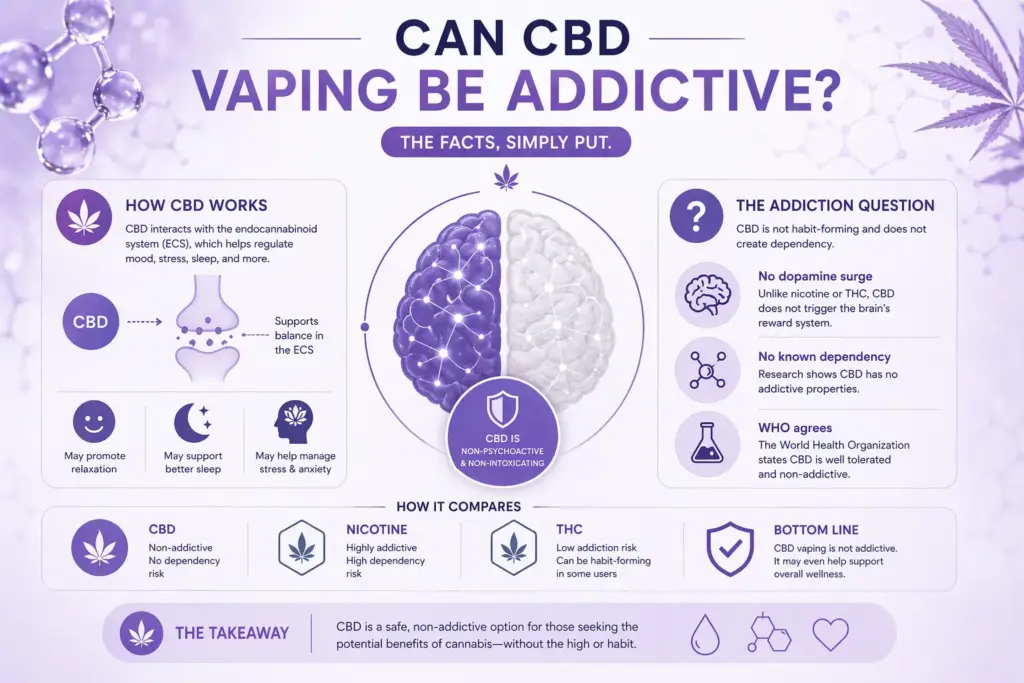
No, cannabidiol CBD is not considered chemically addictive according to current research. The World Health Organization’s 2017 critical review concluded that pure CBD shows no evidence of abuse or dependence potential in humans.
This means that vaping CBD, when the product contains only CBD without nicotine or significant THC, does not carry the same addiction potential as traditional nicotine vapes.
That said, CBD vaping can become a behavioural habit, something you reach for regularly because it feels comforting or helps you unwind.
This is fundamentally different from substance addiction, which involves tolerance, withdrawal symptoms, and loss of control.
The real addiction risk with any vape product typically comes from added nicotine or undeclared high levels of THC.
If you stick to verified, nicotine-free CBD vapes that comply with UK, EU, or US hemp laws containing less than 0.2 to 0.3% THC depending on your region, chemical addiction is highly unlikely.
At a Glance: CBD Vaping and Addiction
| Factor | What You Should Know |
|---|---|
| CBD itself | Not addictive; no abuse potential found |
| Habit formation | Possible, but manageable without withdrawal |
| Nicotine content | Check labels, must be 0mg for no addiction risk |
| THC levels | Legal products contain trace amounts only |
| Your action | Always verify lab reports and ingredients |
Many people conflate “vaping” with “nicotine” because nicotine vapes dominated the market first. This leads to the assumption that all vaping products carry addiction risk.
Understanding the fundamental difference between CBD and nicotine clears up this confusion.
Nicotine is a highly addictive substance that works by flooding your brain’s pleasure centers with dopamine. This creates a powerful reward response that your brain wants to repeat.
Over time, you develop tolerance, needing more to feel the same effect, and experience withdrawal symptoms like irritability, cravings, and restlessness when you stop.
Nicotine’s interaction with brain receptors makes it one of the most dependency-forming substances known.
CBD, by contrast, is a non-intoxicating compound from the cannabis plant that interacts with your body’s endocannabinoid system in a completely different way. Unlike THC, CBD does not directly stimulate dopamine release in the brain’s reward pathways.
There’s no euphoric effects, no “high,” and no compulsive seeking behaviour. Research suggests CBD doesn’t create the neurological changes that lead to addiction.
How to Avoid Accidental Nicotine Exposure:
The late 2010s saw a surge in both nicotine vaping and CBD vapes entering the same retail spaces, which created consumer confusion. Today, reputable brands make the distinction clear, but you should always verify.
CBD is one of over 100 cannabinoids found in the hemp plant. Unlike THC, the psychoactive compound responsible for the cannabis “high,” CBD exhibits no intoxicating properties.
This distinction matters enormously when discussing addiction potential.
The reason CBD is not addictive comes down to brain chemistry. When you consume CBD, it interacts with the endocannabinoid system without strongly stimulating CB1 receptors in the brain’s reward centres.
This is fundamentally different from how nicotine or THC work.
Without that direct dopamine surge, there’s no reinforcing “rush” that drives compulsive use.
The World Health Organization addressed this directly in their 2017 Expert Committee on Drug Dependence review. Their findings stated:
A 2017 study published in Drug and Alcohol Dependence reinforced these findings. Researchers found that CBD had the same dependence potential as a placebo pill in controlled conditions.
No participants developed tolerance, cravings, or withdrawal symptoms from CBD use.
What Current Evidence Says About CBD and Addiction:
Interestingly, some CBD research is exploring whether CBD could aid in treating addiction to substances like tobacco or opioids.
A pilot study found that inhaled CBD helped participants reduce cannabis and cigarette consumption over 12 weeks, suggesting potential benefits for addiction recovery, though this isn’t a standalone treatment.
Understanding the distinction between addiction and habit is crucial for anyone considering regular CBD use.
Addiction involves:
Habit involves:
The act of vaping itself, the hand-to-mouth motion, inhaling and exhaling visible vapour, enjoying flavours, can become a comforting routine.
Many CBD users report reaching for their vape pens when stressed or anxious. This behavioural pattern can feel reinforcing even without an addictive substance involved.
This is sometimes called “behavioural dependence” or simply habitual use. You might rely on your CBD vaping experience whenever anxiety spikes or before bed.
The calming ritual becomes associated with relief, even though CBD itself isn’t creating chemical dependency.
Practical Tips to Keep CBD Vaping in Balance:
For most adults taking CBD within commonly studied amounts, habitual use does not equate to chemical addiction.
You can develop a routine without developing dependence.
If you find stopping feels difficult or causes significant distress, that’s worth examining, but it’s unlikely to involve the severe forms of withdrawal associated with addictive substances.
If you want to be more intentional with how and when you use your vape, this guide to crafting the perfect CBD vaping routine may help.
Not all CBD vapes are created equal. Understanding product types and quality markers helps you avoid hidden risks that could undermine the non-addictive profile of CBD.
CBD vapes fall into three broad categories:
| Type | What It Contains | THC Level |
|---|---|---|
| Full spectrum CBD | All hemp cannabinoids including legal trace THC | Up to 0.2 to 0.3% |
| Broad spectrum | Multiple cannabinoids with THC removed | Non-detectable |
| CBD isolate | Pure CBD only | Zero |
Legal hemp-derived CBD products in the UK, EU, and US must contain only trace THC, typically under 0.2% in the UK and EU or 0.3% in the US.
At these levels, you won’t experience psychoactive effects or develop THC dependence through normal use.
The trace amounts simply aren’t sufficient to trigger the same potential for abuse that high-THC medical cannabis or recreational cannabis products might carry.
However, poorly regulated or black-market vaping products pose genuine risks. These may:
How to Choose Safer CBD Vape Products:
Both CBD and THC exist on a spectrum of products. People using high-THC cannabis vapes, not CBD-only products, may experience dependence over time.
This risk should not be confused with legal CBD vaping, which involves fundamentally different cannabinoid profiles.
If you are comparing formulations, it may also help to read about CBD isolate vape juice and broader broad spectrum CBD benefits.
Being non-addictive doesn’t mean risk-free. Separating addiction concerns from general health risks gives you a complete picture before you start or continue vaping CBD.
Inhaling any vapour introduces your lungs to aerosolised substances. While CBD itself doesn’t show addiction potential, research on long-term inhalation effects remains limited.
Early studies suggest some CBD vapour formulations may affect lung tissue or cardiovascular markers, though comprehensive human data is still developing.
Key concerns with vaping include:
Critical Formulation Warning:
Never vape oral CBD oils. Products designed for sublingual use often contain carrier oil like MCT oil, hemp seed oil, or olive oil. Vaping these oils risks serious lung complications.
Only use vape liquid specifically designed for vaping devices, typically PG or VG-based formulations clearly labelled for inhalation.
Who Should Consult a Healthcare Provider First:
If inhalation concerns you, alternatives exist. Sublingual CBD oil, capsules, and other oral formats can offer similar effects without vapour.
These methods bypass lung exposure entirely while still allowing you to experience the potential benefits of cannabidiol.
How to Use CBD Vapes More Safely:
For practical guidance around strength and device performance, see also choosing the right CBD vape strength and why some CBD vapes pack a bigger punch.
This section answers quick, real-world questions about CBD vaping, addiction, legality, and what to expect.
Is CBD vape addictive like nicotine vapes? No. Nicotine creates dependence through dopamine pathway stimulation. CBD lacks this mechanism entirely. As long as your CBD vape contains no nicotine and only trace legal THC, addiction risk is minimal based on current research.
Can I get high from a CBD vape? No. CBD is non-intoxicating with no psychoactive effects. Legal CBD products contain only trace THC, which is far too low to produce intoxication. You may feel calm or relaxed, but this is not the same as a THC high.
Can CBD vapes help me quit smoking or nicotine vaping? Emerging research suggests CBD may help reduce drug cravings, including tobacco cravings. A pilot study showed participants reduced cigarette use alongside cannabis consumption when using inhaled CBD. However, CBD is not a guaranteed or standalone cessation treatment.
Will I get withdrawal symptoms if I stop using CBD vape? Current data show no classic withdrawal syndrome from pure CBD. You may miss the habit or calming routine, but this differs from the irritability, cravings, and physical discomfort associated with nicotine or high doses of THC cessation.
How much CBD should I vape per day? Start low. Many beginners use 10 to 25mg daily and adjust based on response. Follow product guidance and stay within commonly studied ranges. If you also use other CBD formats like CBD oil or capsules, account for total daily intake.
Are CBD vapes legal where I live? Hemp-derived CBD vapes are legal in the UK, EU, and US when THC content stays under regional limits. Regulations evolve, so check local rules for the most current requirements. Some regions restrict sales to adults over 18 or 21.
Can I mix CBD and nicotine in the same vape? Technically possible, but it defeats the purpose if you’re trying to avoid addiction. Nicotine remains a highly addictive substance regardless of what it’s mixed with.
Should I consult a doctor before using CBD vapes alongside medications? Yes. CBD can inhibit certain liver enzymes that metabolise other medications, potentially affecting drug levels in your body. Discuss with your healthcare provider if you take prescription medications.
Are disposable CBD vapes safer than refillable ones? Both disposables and refillable vape pens can be safe if they’re from reputable brands with third-party testing. Disposable products offer convenience, while refillable systems give you more control over vape liquid quality.
Understanding the difference between habit and chemical addiction empowers you to make informed choices about your CBD vaping experience.
By choosing verified, nicotine-free products from reputable sources, you can explore what CBD offers without the addiction concerns that surround nicotine vaping.
Start low, pay attention to your body, and don’t hesitate to explore non-inhalation alternatives if they better suit your needs.

Message us directly
I will be back soon

