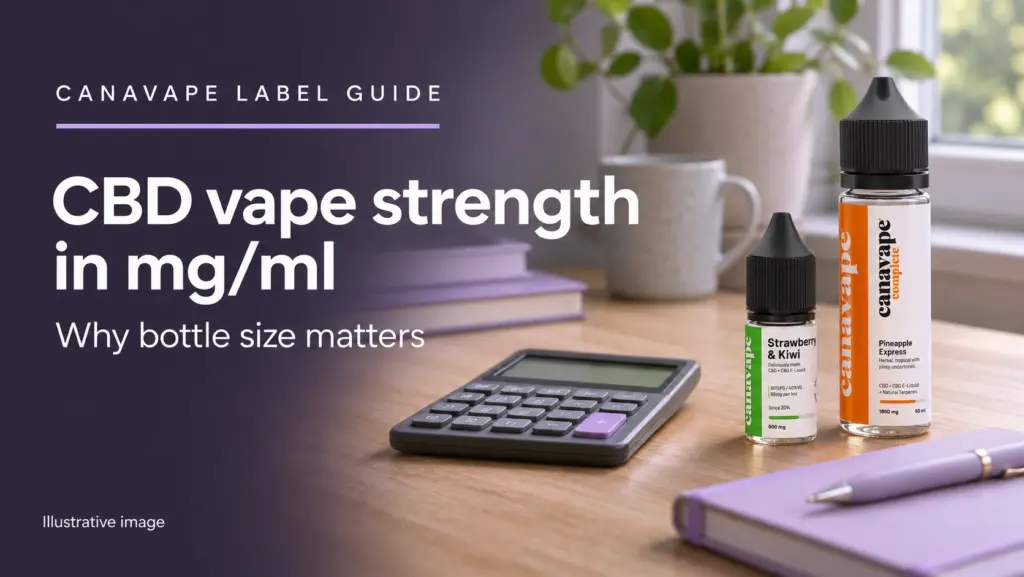
CBD vape strength in mg/ml tells you how much CBD is present in each millilitre of liquid. To calculate it, divide the stated CBD milligrams by the liquid volume in ml. If the label gives combined cannabinoids instead, the answer is combined cannabinoid concentration—not CBD concentration alone.
A larger bottle can contain more milligrams overall while being less concentrated. That is why 1800mg in 50ml is not automatically stronger than 600mg in 10ml. You need to check both the number and what that number measures.
This guide is about reading labels and doing the arithmetic. It does not prescribe a personal dose, estimate absorption or convert milligrams into a guaranteed number per puff.
Start by identifying the ingredient measured. A bottle labelled 600mg CBD and a bottle labelled 600mg CBD + CBG may have the same headline number while containing different amounts of CBD.
For example, the checked Canavape Vanilla Custard 10ml listing states 600mg total cannabinoids: 500mg CBD plus 100mg CBG. That means 50mg CBD per ml, 10mg CBG per ml and 60mg combined cannabinoids per ml.
Writing the breakdown makes the comparison clearer than describing the bottle simply as “600mg CBD”.
CBD milligrams ÷ liquid millilitres = CBD mg/ml.
If a 10ml bottle contains 500mg CBD, calculate 500 ÷ 10 = 50mg CBD/ml. If it also contains 100mg CBG, calculate 100 ÷ 10 = 10mg CBG/ml separately. The combined concentration is 60mg/ml.
Use the same approach for a combined cannabinoid figure, but keep the label attached to the result: total cannabinoid milligrams ÷ liquid ml = combined cannabinoid mg/ml.
Do not use the size of the plastic container if it is larger than the liquid supplied. A 60ml-capacity bottle containing 50ml of liquid has 50ml as the starting denominator. Bottle space matters only when you add more liquid.
| Illustrative bottle | Calculation | Concentration of the stated ingredient |
|---|---|---|
| 600mg in 10ml | 600 ÷ 10 | 60mg/ml |
| 1000mg in 50ml | 1000 ÷ 50 | 20mg/ml |
| 1800mg in 50ml | 1800 ÷ 50 | 36mg/ml |
| 2000mg in 100ml | 2000 ÷ 100 | 20mg/ml |
These examples compare the arithmetic only. The stated ingredient must be the same before you use the table to compare products: CBD alone with CBD alone, or combined cannabinoids with combined cannabinoids.
The 2000mg bottle in this table contains the most milligrams overall, but the 600mg 10ml bottle has the highest concentration. Total quantity and concentration answer different questions.
Think of total milligrams as the amount across the whole bottle. Think of mg/ml as how that amount is distributed through the liquid. Both numbers are useful, but one cannot replace the other.
Canavape’s checked 10ml Vanilla Custard formulation contains 600mg combined cannabinoids in 10ml, giving 60mg/ml. The checked Granddaddy Purple Canavape Complete formulation contains 1800mg total cannabinoids in 50ml, giving 36mg/ml.
Complete has more total cannabinoids and more liquid. The 10ml example has the higher combined concentration. That does not settle which one you should buy, because the formulations and flavour styles also differ.
For the actual buying decision, compare 10ml CBD vape juice with Canavape Complete on bottle size, flavour, profile and device suitability as well as concentration.
A percentage is only useful once you know its basis. Some e-liquid listings use a mass-per-volume convention: 1g of the stated ingredient per 100ml is 1% weight/volume, equivalent to 10mg/ml.
On that basis, 600mg in 10ml corresponds to 6% combined cannabinoids, and 1800mg in 50ml corresponds to 3.6%. For the checked 10ml CBD + CBG example, the separate figures would be 5% CBD and 1% CBG on the same basis.
However, a weight/weight percentage means grams per 100g rather than per 100ml. You need density to convert that precisely to mg/ml. Do not assume a percentage on an extract, cartridge and bottled e-liquid uses the same convention.
When the percentage basis is unclear, use the explicit milligrams and supplied liquid volume where available, or ask the seller to clarify. Avoid converting a cartridge percentage into an e-liquid concentration without the information needed.
Mg/ml describes the liquid in the bottle. It does not tell you exactly how much liquid is used in one puff, how much reaches the user or how much is absorbed.
Puff duration, device power, airflow and the particular pod all affect liquid consumption. Two people can use the same bottle and device differently. This is why a universal claim such as “one puff equals a fixed number of milligrams” should not be inferred from the bottle label.
A nominal 2ml pod filled with liquid at 36mg combined cannabinoids per ml would contain approximately 72mg across the liquid in the full pod. That is a statement about its contents, not a suggested serving or the amount delivered in one session.
For personal questions involving health, medicines or appropriate use, speak with a qualified healthcare professional. A concentration calculator cannot answer those questions.
Both the total milligrams and the liquid volume change. The correct calculation is: (original milligrams + added milligrams) ÷ (original ml + added ml). Keep the cannabinoid measurement consistent throughout.
For example, 50ml containing 1800mg combined cannabinoids plus a compatible 10ml shot containing 1200mg gives approximately 60ml containing 3000mg. The result is 3000 ÷ 60 = 50mg/ml.
Dividing 3000mg by the original 50ml would incorrectly give 60mg/ml because it ignores the extra liquid. This is one of the easiest mixing mistakes to avoid.
If you are planning a blend, read the Full Spectrum Vape Additive Shot instructions and our shortfill guide before mixing. Arithmetic alone does not establish ingredient or device compatibility.
Yes. Adding a cannabinoid-free compatible base increases the volume without adding milligrams. For example, a hypothetical 600mg in 10ml becomes 600mg in 20ml if you add 10ml of such a base: 30mg/ml instead of 60mg/ml.
Adding a lower-concentration cannabinoid liquid can also reduce the final concentration, even though the total milligrams rise. Calculate first rather than assuming a product called a “shot” always increases strength per ml.
Only mix products that are suitable for the intended blend. This explanation is about the maths, not a recommendation to dilute any particular bottle.
Price per ml tells you the cost of liquid volume. Price per 100mg of the stated cannabinoids tells you the cost of that quantity. Each can be useful, provided you keep the formulation differences visible.
Price per 100mg = bottle price ÷ stated milligrams × 100. A hypothetical £20 bottle containing 1000mg of a clearly specified ingredient costs £2 per 100mg of that ingredient.
This does not account for flavour preference, cannabinoid balance, formulation or how much of the product you actually want to buy. A lower number is not automatically the better match.
Our guide to CBD cartridge prices discusses the separate factors involved in comparing prefilled products. Avoid mixing cartridge and e-liquid figures into one table unless the units and contents are clear.
Not necessarily. If 1000mg is spread through 50ml, it is 20mg/ml. If 600mg is in 10ml, it is 60mg/ml. Check that both totals refer to the same ingredient before comparing.
Only if the percentage means CBD weight/volume. If it refers to combined cannabinoids, the figure is combined concentration. If it is weight/weight, density matters. Check how the percentage is defined.
The checked Vanilla Custard listing states 500mg CBD plus 100mg CBG per bottle. One ml therefore contains 50mg CBD and 10mg CBG, totalling 60mg cannabinoids. Refer to the particular product you buy.
Not by itself. You also need the liquid quantity and actual consumption. Devices and use patterns vary, so mg/ml alone cannot predict days of use.
No. Concentration describes the formulation, not a guaranteed result. Flavour, cannabinoid profile, device compatibility and your preferences remain part of choosing a product.
Write down the liquid volume, CBD amount and any separate cannabinoid amounts. Calculate each concentration using the same denominator, then compare like with like.
Once the numbers make sense, use the existing strength buying guide and flavour guide for the wider product choice. Browse CBD e-liquids with a clearer understanding of what the label actually tells you.
For related guidance, read the practical comparison of 10ml juice and Canavape Complete and the additive versus ready-to-vape mixing guide.
Canavape product examples checked on 16 November 2026. Calculations use nominal stated volumes. This is product-label education, not dosing advice. For adults aged 18 and over.
Message us directly
I will be back soon

