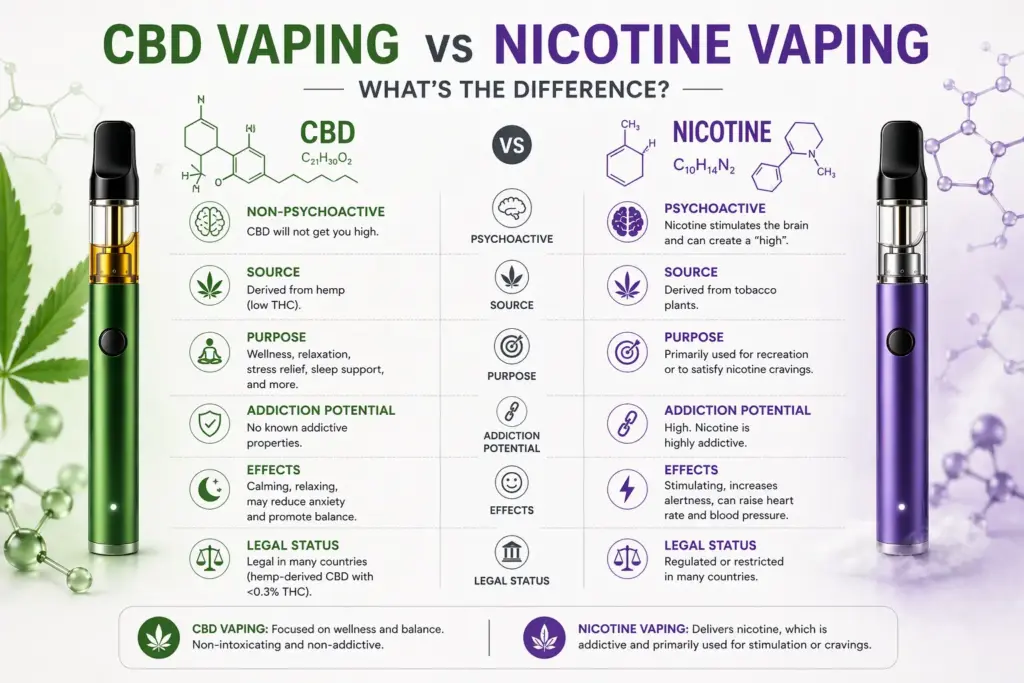
If you’re exploring vaping options, you’ve likely encountered two very different products sitting side by side: CBD vapes and nicotine vapes.
While both involve inhaling vapour from a heated liquid, often contained within a vape cartridge or pod… the similarities largely end there.
The active ingredients, intended purposes, effects on your body, and risk profiles differ significantly between these two categories.
Understanding these differences matters, whether you’re a smoker looking for alternatives, someone curious about CBD for relaxation, or simply trying to make sense of an increasingly crowded market.
This guide breaks down everything you need to know about CBD vaping versus nicotine vaping, from what’s actually inside each product to how they feel and what current research says about safety, addiction, and real-world use.
If you are completely new to CBD vaping, you may also want to read our guides on how CBD vape devices work, what’s in CBD vape juice, and whether CBD vaping contains nicotine. Those pieces pair perfectly with this comparison.
The core distinction comes down to what you’re actually inhaling.
CBD vapes contain cannabidiol, a non-intoxicating compound extracted from hemp plants that does not produce a high and is generally considered non-addictive.
Users typically reach for CBD vape products when seeking relaxation, stress support, or relief from everyday discomfort.
Nicotine vapes, on the other hand, deliver a stimulant derived from tobacco plants.
Nicotine is highly addictive and works by stimulating your central nervous system, providing a short-lived boost in alertness and mood.
Most people use nicotine vapes either to satisfy existing cravings or as a tool for quitting smoking.
Here’s what you should keep in mind about both options:
Who typically uses each? Nicotine vapes generally suit smokers or ex-smokers managing cravings and working toward quitting.
CBD vapes tend to attract people seeking non-nicotine relaxation or symptom support without the addictive properties of tobacco-derived products.
For readers specifically comparing CBD to smoking-related products, our articles on can CBD vaping be addictive and the disposable vape ban in the UK add useful extra context.
CBD, short for cannabidiol, is one of the major cannabinoids found in cannabis plants.
Unlike THC, the compound responsible for marijuana’s intoxicating effects, CBD does not produce a high.
Most commercial CBD products are derived from hemp strains that contain less than 0.3% THC in the US or 0.2% THC in the UK and EU, making them legal in many jurisdictions when formulated correctly.
When it comes to vaping CBD, the products typically contain:
It is important to understand that properly formulated CBD vape liquids are specifically designed for inhalation.
This is not the same as standard CBD oil intended for oral use. Putting an oral tincture into a vape device is a serious mistake and can create unnecessary risk.
A CBD vape device works much like any other vaporiser. A battery powers a heating element, which warms the e-liquid and turns it into an inhalable aerosol.
Common formats include refillable vape pens, pod kits, and prefilled CBD vape cartridges.
If you want a deeper mechanical explanation, see How CBD Vape Devices Work: A Simple Explanation.
If you are more interested in ingredients and formulation, What’s in CBD Vape Juice? breaks that down in detail.
CBD is not considered intoxicating and will not produce the effects associated with THC. The World Health Organisation and wider regulatory discussion around CBD have long treated cannabidiol as having a relatively favourable safety profile at appropriate doses.
However, that conversation mostly centres on oral use, not vaping, which has its own separate considerations.
Before diving into why people use CBD vapes, it’s worth noting that evidence for CBD’s benefits is still developing.
Most CBD vape products are sold as wellness items, not licensed medicines, and brands should not make medical claims about them.
That said, people commonly report using CBD vapes for:
One reason people choose to build a CBD vaping routine rather than rely only on capsules or gummies is the speed of onset.
Inhaled CBD usually reaches the bloodstream faster than swallowed products, which is why many users feel that vaping is better suited to moments when they want more immediate support.
Some people also compare CBD vape use with evening routines, especially when trying to separate work from rest.
If that’s your focus, our article on the best CBD vape strength for evening use in the UK may help you refine your approach.
“Natural” does not automatically mean “risk-free,” especially when you are heating and inhaling substances into your lungs.
This is an important point to stress, regardless of how wellness-focused some CBD branding may appear.
Common side effects reported by CBD vapers include:
What does the research say? A 2023 study from Roswell Park, published in Thorax, examined the effects of CBD aerosols on mice and human cells.
The researchers found that CBD vapour from a commercial product using an MCT oil base caused strong inflammatory responses, oxidative stress, and markers of tissue injury.
This does not mean that all CBD vapes are equally harmful, but it does underline how much formulation matters.
It is important to contextualise those findings. The study involved controlled short-term exposure in animals and cells, not ordinary long-term human use.
Still, the results are serious enough that responsible consumers should avoid assuming that CBD vaping is harmless just because CBD itself is non-intoxicating.
Factors that influence risk include:
That is why product selection matters so much. Our articles on why some CBD vapes feel smoother than others, why CBD vapes lose flavour, and how to store CBD vape liquid properly are all relevant if you want to minimise avoidable issues.
Nicotine is a naturally occurring stimulant alkaloid found primarily in tobacco plants. It is the compound responsible for tobacco’s addictive profile and has traditionally been consumed through smoking.
Nicotine vapes, commonly called e-cigarettes, heat an e-liquid containing:
The key difference from smoking is that no tobacco leaf is burned. This eliminates tar and carbon monoxide, which are among the most harmful outputs of cigarette combustion.
Common nicotine device styles include disposable vapes, refillable pods, vape pens, and more advanced box-type devices.
The experience varies depending on whether the liquid uses freebase nicotine or nicotine salts. Nicotine salts are smoother at higher strengths and are widely used in pod systems.
In the UK and EU, nicotine vaping is regulated under the Tobacco Products Directive. This creates a more defined legal framework than the one surrounding many CBD products.
The main reason nicotine vapes exist is to offer a lower-risk alternative for adult smokers who would otherwise continue using combustible tobacco. In that context, they can play a harm-reduction role.
Nicotine’s effects on the body typically include:
People generally use nicotine vapes:
If you do not already use nicotine, there is usually no good reason to start. Unlike CBD, nicotine is a highly addictive substance, and a nicotine vaping habit can form quickly.
Let’s be clear: nicotine is addictive. It can raise heart rate and blood pressure in the short term, and long-term cardiovascular effects remain a real concern.
How nicotine vaping compares to smoking:
| Factor | Cigarette Smoking | Nicotine Vaping |
|---|---|---|
| Combustion | Yes, produces tar, carbon monoxide, and thousands of chemicals | No, heating only |
| Cancer risk | Very high and well established | Likely lower than smoking, but not zero |
| Cardiovascular impact | Major long-term risk | Lower than smoking, but nicotine still affects the heart |
| Respiratory effects | COPD, chronic bronchitis, emphysema | Cough, irritation, uncertain long-term effects |
For current smokers who switch completely, public health messaging in the UK has often treated nicotine vapes as preferable to continuing to smoke.
That does not mean they are harmless. It means the comparison is relative to cigarettes, not to breathing clean air.
Nicotine dependence can show up as:
This is a major difference from CBD vaping, which does not carry the same established dependence profile.
The reasons adults choose CBD vapes versus nicotine vapes are fundamentally different.
Nicotine vapes are mainly used:
CBD vapes are mainly used:
That difference in purpose affects how people use them.
Nicotine vaping is often frequent and driven by dependence management. CBD vaping is more likely to be situational, for example after work, before bed, or during especially stressful periods.
If you are someone weighing up whether a CBD product suits your routine better than nicotine, articles such as Crafting the Perfect CBD Vaping Routine and Understanding CBD Vape Strength may help you think more clearly about how and when CBD fits into daily life.
These examples illustrate how different consumers typically approach each product type:
Although both product categories use similar delivery hardware, what is actually inside the pod, cartridge, or bottle can vary dramatically.
Critical warning: some legacy or badly made CBD products use oil-based carriers. These are not appropriate for vaping. For more on formulation issues, read What’s in CBD Vape Juice? and CBD Vape Oil UK Guide.
| Component | Nicotine E-Liquid | CBD E-Liquid |
|---|---|---|
| Active substance | Nicotine | CBD |
| Addiction potential | High | Low / non-addictive |
| Typical purpose | Craving relief or smoking cessation | Relaxation and non-nicotine use |
| Typical base | PG/VG | PG/VG preferred for inhalation |
| Common extras | Flavourings | Terpenes, minor cannabinoids, flavourings |
| Main quality concern | Nicotine strength accuracy and contaminant control | Correct inhalation formulation and contaminant control |
Some consumers ask whether they can mix CBD and nicotine in the same device.
Technically, people do experiment with this, but it is usually not the best approach.
It makes dosing harder to track, blurs the experience, and in some regulated markets pre-mixed products are restricted or effectively prohibited.
If your goal is quitting nicotine, you are generally better off stepping down nicotine strength intentionally rather than muddling the process by combining multiple active ingredients.
If your goal is relaxation, a dedicated CBD product makes more sense than one that still contains an addictive stimulant.
This is where the difference becomes obvious to most users.
Nicotine vaping usually feels fast, punchy, and immediately noticeable:
This is why many nicotine users vape frequently throughout the day rather than only at selected times.
CBD vaping usually feels more subtle and gradual:
Of course, the exact feel depends on the product. Factors like terpene choice, voltage, coil type, and PG/VG ratio can all affect whether a CBD vape feels smooth or harsh.
If that is something you have struggled with, see Why Some CBD Vapes Feel Smoother Than Others and Why Some CBD Vapes Pack a Bigger Punch.
If you are switching from nicotine and expecting CBD to replace that same buzz, you may be disappointed. CBD is not a stimulant and does not behave like nicotine.
It may still fit into your routine well, but only if your expectations match what it actually does.
Many consumers assume CBD vapes are automatically safer because CBD is non-addictive and tied to wellness culture. That assumption is too simplistic.
The reality is more nuanced:
Public health discussions often place nicotine vapes below cigarettes in relative risk for existing smokers who switch fully. But that is a comparison against smoking, not against clean air.
Meanwhile, CBD vapes may avoid addiction concerns while still raising significant questions about inhalation safety, especially when formulation quality is poor.
Experimental data suggests certain CBD aerosols can produce pronounced inflammatory responses.
Nicotine vapes carry established dependence risks and potential cardiovascular consequences. In other words, the main concerns differ, but neither side is risk-free.
Safety depends on multiple variables:
The most sensible conclusion is this: both nicotine and CBD vapes are harm-reduction tools at best, not harmless lifestyle essentials.
For a quick visual comparison, here’s how the two product categories differ across the factors most people care about:
| Factor | CBD Vapes | Nicotine Vapes |
|---|---|---|
| Source | Hemp | Tobacco |
| Main effect | Relaxation, perceived calm | Stimulation, craving relief |
| Addiction potential | Low / non-addictive | High |
| Typical users | Wellness-focused adults, ex-smokers wanting non-nicotine options | Current smokers, former smokers, nicotine users |
| Onset | Within minutes | Within seconds |
| Subjective feel | Subtle calm, no rush | Buzz, throat hit, quick satisfaction |
| Main legal framework | Consumer safety / hemp rules | Tobacco and e-cigarette regulation |
| Main safety concern | Formulation and respiratory irritation | Addiction and cardiovascular impact |
| Best fit | Adults seeking nicotine-free vaping | Smokers trying to reduce or replace cigarettes |
Neither CBD nor nicotine vapes are completely safe. Both involve inhaling heated aerosols into the lungs, and long-term outcomes are still being studied.
Nicotine vapes make the most sense for confirmed adult smokers looking to move away from cigarettes.
In that setting, they can serve as a lower-risk option than smoking. CBD vapes may suit adults who want a non-nicotine route for relaxation or wellness support, provided they choose properly formulated products and understand the limitations of current evidence.
If you are leaning toward CBD specifically, it helps to understand the wider category. These additional reads may help:
If you are not currently a smoker or a vaper, the safest option may be to skip both. Neither product is necessary for a healthy lifestyle, and introducing inhaled substances without a clear reason rarely makes sense.
Whatever you decide, go in with realistic expectations, choose quality products, and stay informed.
A clear understanding of CBD vaping vs nicotine vaping is the best way to make a decision that actually suits your needs rather than the marketing around either category.

Message us directly
I will be back soon

