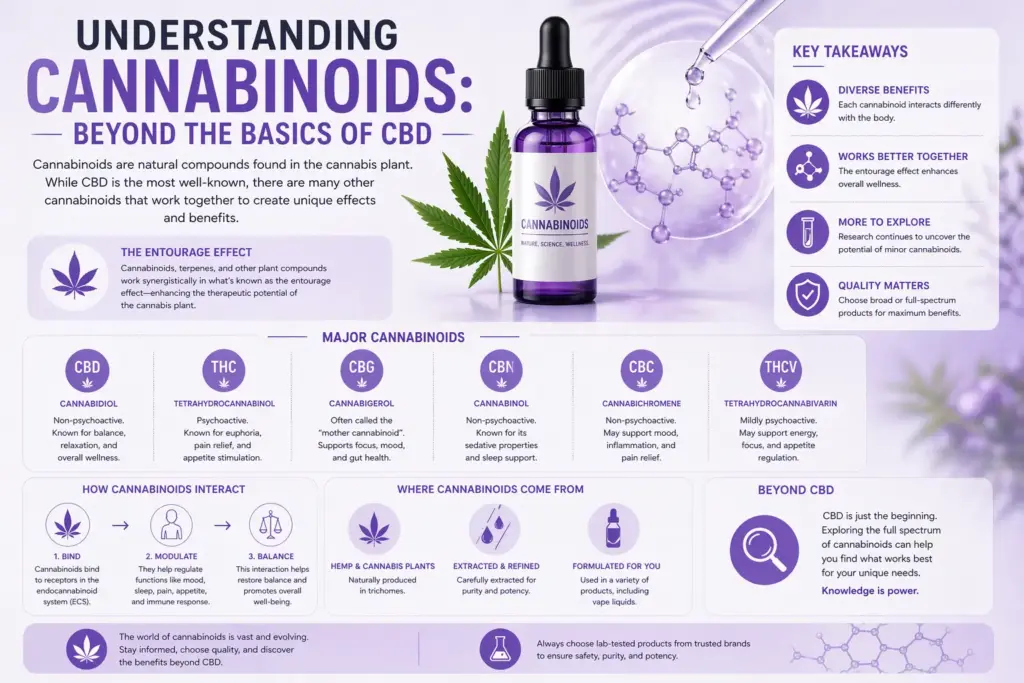
Most people think cannabinoids are just about CBD. That idea misses out on a whole world of compounds with unique effects, different roles in the body, and growing importance in modern wellness.
If you want to understand cannabinoids beyond the basics of CBD, this guide will clear things up and show you what really matters.
Over the last few years, CBD has become the name most people recognise first. It appears in oils, capsules, creams, CBD vape products, and countless wellness conversations.
But CBD is only one cannabinoid among many.
Once you look a little deeper, you start to see why compounds like CBG and CBN are attracting so much interest, and why the broader cannabinoid picture is far more interesting than most people realise.
Understanding cannabinoids properly helps you choose products more intelligently, interpret labels more confidently, and build a routine around what you actually want to feel.
Whether your interest is relaxation, balance, evening use, or simply understanding what is inside your vape, getting clear on cannabinoids is the foundation.
Cannabinoids are more than just CBD.
They offer a world full of diverse compounds with varying impacts. Some are associated with calm, some with focus, some with sleep support, and others are still being studied for their future potential.
The more you understand them, the more obvious it becomes that not all cannabis-derived compounds do the same thing.
At the simplest level, cannabinoids are naturally occurring compounds found in cannabis plants.
These compounds interact with the body in meaningful ways, especially through a system called the endocannabinoid system.
That interaction is the reason cannabinoids can influence how you feel, how you unwind, and how certain wellness products perform.
Cannabinoids are chemical compounds found in cannabis plants. They interact with the body’s systems to produce various effects. CBD, a well-known cannabinoid, is just one of many.
These compounds work by binding to receptors in the body, influencing things like mood, appetite, and pain perception.
Each cannabinoid has its own profile and effects, making them unique in their own way.
The key point is that cannabinoids are not interchangeable. They may come from the same plant, but they can feel very different in use.
For example, CBD is usually associated with balance and calm, while CBG is more often discussed in relation to clarity and a more daytime-friendly feel.
CBN, on the other hand, has become closely associated with evening routines and wind-down products. If you want a direct comparison, see CBD vs CBG and CBD vs CBN.
That difference is exactly why broad-spectrum, full-spectrum, and multi-cannabinoid products have become so important.
Many people now want more than a simple isolate. They want a fuller experience that reflects how cannabinoids naturally work together.
For an in-depth overview of the endocannabinoid system read this article here.
Cannabinoids have been used for thousands of years. Ancient cultures utilised cannabis for medicinal and spiritual purposes.
From traditional Chinese medicine to Ayurvedic practices, cannabinoids have played a role in healing. In the modern era, interest in cannabinoids has surged, driven by research and changing laws.
Understanding this history helps us appreciate the potential and versatility of cannabinoids today.
What has changed most in the modern era is not just access, but understanding. In the past, cannabis was often treated as one broad category.
Today, manufacturers and consumers increasingly separate out the compounds that matter.
People want to know whether a product is isolate-based, broad-spectrum, terpene-rich, full-spectrum, daytime-friendly, or better suited to the evening.
This more precise understanding has helped shape today’s market, especially in the UK where product education matters.
As education improves, customers are asking sharper questions: does a product contain THC, does it contain nicotine, how strong is it, and how does one cannabinoid compare to another?
Those are exactly the kinds of questions answered in guides like does CBD vape contain THC? and does CBD vaping contain nicotine?.
The world of cannabinoids is broad and diverse. While THC and CBD are the most widely recognised names, they are far from the only ones worth knowing.
In practical terms, understanding the main cannabinoids gives you a better idea of why one product may feel smoother, stronger, more calming, or more functional than another.
THC and CBD are the two most famous cannabinoids. THC is known for its psychoactive effects, giving users a high.
It’s often used for recreational purposes but also has therapeutic benefits. CBD, on the other hand, doesn’t cause a high.
Instead, it’s praised for its calming and anti-inflammatory properties. Both have unique benefits, making them popular choices for different needs.
In the UK, this distinction is especially important. Most people exploring legal wellness products are looking at CBD rather than THC.
That is one reason why pure CBD products and compliant broad-spectrum options remain so popular. The aim is to support calm, relaxation, and general balance without intoxication.
It is also worth noting that confusion around THC still affects how many people view cannabis-derived compounds as a whole.
Some assume all cannabinoids are intoxicating, when in reality CBD, CBG, and CBN are generally discussed in non-intoxicating product contexts.
That misunderstanding is part of why education matters so much.
Beyond THC and CBD, there are lesser-known cannabinoids like CBG and CBN. CBG is gaining attention for its potential to reduce inflammation and pain. CBN is often associated with promoting sleep and relaxation.
These cannabinoids offer distinct benefits and are becoming more popular as people seek alternatives to traditional medicine.
CBG is particularly interesting because it is often referred to as the “mother cannabinoid.” Many other cannabinoids begin as acidic precursor forms that trace back to CBG during plant development.
In practical terms, users often describe CBG products as clearer, more focused, and more suitable for daytime support. If you want to explore that more deeply, see what is CBG in vapes?.
CBN, by contrast, is often discussed in evening or bedtime contexts.
Many people encounter it when looking for products designed to help them switch off. Its popularity has grown alongside customer interest in structured routines such as the best CBD vape strength for evening use.
Other cannabinoids continue to emerge in research and specialist discussions, but for most consumers, the key compounds to understand today are CBD, THC, CBG, and CBN.
Once you understand what each tends to be associated with, product labels begin to make a lot more sense.
Cannabinoids interact with the body in fascinating ways.
They are not random ingredients that simply “do something.” Their effects are connected to a built-in biological system that helps your body regulate itself.
The endocannabinoid system is a complex network of receptors. Cannabinoids bind to these receptors, influencing various bodily functions.
This system helps regulate mood, appetite, sleep, and pain. By interacting with this system, cannabinoids can have a wide range of effects on the body and mind.
Put simply, the endocannabinoid system helps maintain balance. That is why cannabinoids are so often discussed in relation to calm, recovery, sleep, discomfort, and general wellbeing.
Different cannabinoids interact with the system differently, which is one reason their effects do not feel identical.
CBD is often described as working more indirectly, while other cannabinoids may interact more directly with specific receptor pathways.
That difference matters when formulating products. It is also part of why some blends feel more complete than a simple single-cannabinoid isolate.
If you want to understand how cannabinoids work together rather than alone, read the entourage effect and cannabinoids explained.
This concept is central to understanding why full-spectrum and broad-spectrum products often appeal to experienced users.
Cannabinoids can affect both the body and mind. Physically, they can reduce inflammation, alleviate pain, and improve sleep.
Mentally, they can enhance mood, reduce anxiety, and promote relaxation. Each cannabinoid has its own effects, allowing you to choose what suits your needs best.
In real-world use, this means one person may use CBD to take the edge off after work, another may choose a CBD and CBG blend for daytime clarity, while someone else may prefer a CBD and CBN-oriented evening routine.
The compound itself matters, but so do strength, formulation, and delivery method.
For vaping specifically, onset time also changes the experience. Vaping tends to be faster than oils or edibles, which is one reason many people prefer CBD vape cartridges or refillable setups over slower formats.
Cannabinoids offer a variety of applications. The key is understanding that “benefits” are often tied to the right compound, the right strength, and the right timing.
Good products feel intentional. Poorly chosen products often just feel random.
Cannabinoids are used to treat various medical conditions.
They can help manage chronic pain, reduce seizures, and improve sleep quality. Some people use them to combat anxiety and depression.
With ongoing research, the list of medical benefits continues to grow.
In consumer wellness products, the conversation is usually more cautious.
Rather than making medical claims, brands typically position cannabinoids around lifestyle support, calm, balance, and product experience.
That is why it helps to think in terms of what you want a product to support, not what you want it to “cure.”
For example, someone exploring discomfort support may start with CBD, while someone struggling with evening switch-off may explore CBD alongside CBN.
Someone looking for a more focused daytime feel may experiment with CBG. This is why educational content and proper internal linking across topics really matters.
Beyond medical use, cannabinoids are popular for recreation and wellness. Many people use them to relax, unwind, and enhance their overall well-being.
Whether it’s for social enjoyment or personal relaxation, cannabinoids offer a natural way to enhance your lifestyle.
For legal CBD products in the UK, “wellness” is often the clearest category. People may use cannabinoids:
If that sounds familiar, you may want to read CBD vape to quit nicotine, crafting the perfect CBD vaping routine, and why some CBD vapes pack a bigger punch.
It is not enough to understand cannabinoids in theory. You also need to understand how they are delivered.
A cannabinoid in an oil, edible, or vape will not feel exactly the same because onset time and absorption differ.
Vaping remains one of the fastest ways to experience cannabinoids, which is why it suits users looking for a more immediate shift.
If you are exploring this route, a good place to start is the CBD vape starter kit category or the broader CBD vape range.
Product quality matters as well. The same cannabinoid can feel very different depending on how it is formulated, what terpenes are present, and how clean the base ingredients are.
This is one reason why some products feel smoother, while others are harsher or less enjoyable.
For more on this, see why some CBD vapes feel smoother than others and why your CBD vape loses flavour.
The future of cannabinoid research is promising. Let’s explore the latest studies and potential advancements in this exciting field.
New research is constantly emerging. Studies are exploring cannabinoids’ potential to treat conditions like Alzheimer’s and cancer.
As our understanding grows, so does the list of possible benefits. Researchers are uncovering new ways cannabinoids can support health and wellness.
At the consumer level, the biggest practical change is likely to be better-targeted products.
Instead of broad “CBD does everything” messaging, we are moving toward more precise positioning: cannabinoids for evening use, cannabinoids for focus, cannabinoids for smoother vaping, cannabinoids combined with particular terpene profiles, and more.
The field of cannabinoid science is rapidly evolving. Future developments could lead to more effective treatments and new applications.
From personalised medicine to advanced extraction methods, the possibilities are vast.
For everyday users, this likely means better formulations, more transparency, and more refined products that match specific goals.
Expect clearer labelling, more sophisticated blends, and continued movement away from disposable formats towards higher-quality refillable systems and cartridges.
As the category matures, readers who understand cannabinoids beyond CBD will have a clear advantage. They will not just buy based on hype. They will buy based on what a product is actually designed to do.
Once you understand the broader cannabinoid landscape, choosing products becomes much easier. Instead of simply asking “how strong is it?”, you can ask better questions:
That is where educational blog content and proper internal linking matter so much. Someone interested in cannabinoids today may need product help next. A good next step might be exploring CBD vape cartridges, learning more about CBD vape strength, or reading answers to common CBD vape questions in the UK.
Cannabinoids are far more complex and useful than the average beginner realises. CBD may be the gateway into the category, but it should not be the end of the conversation.
CBG, CBN, and other emerging compounds all help show that cannabis-derived wellness is not about one single ingredient.
It is about understanding how compounds work individually, how they work together, and how product quality shapes the experience.
If you only think in terms of CBD, you miss the bigger picture. Once you understand cannabinoids beyond CBD, you can choose more intelligently, build a better routine, and find products that genuinely suit your goals.
To take the next step, explore the full CBD vape category, compare formats, and keep building your understanding of how cannabinoids actually work in the real world.
While both are non-intoxicating compounds derived from the cannabis plant, they are typically associated with very different wellness effects and times of day. CBD is most commonly used for its calming, balancing, and anti-inflammatory properties, making it a popular choice for general daytime or evening relaxation.
CBG, often called the “mother cannabinoid” because other cannabinoids develop from its precursor forms, is associated with mental clarity, focus, and a more active, daytime-friendly feel. Because of these distinct profiles, they are not interchangeable. Consumers often choose CBG-specific products when they want to support alertness during the day without feeling drowsy, whereas they turn to CBD to foster a sense of overall recovery and quiet calm.
CBN has become highly popular for evening and bedtime use because of its close association with wind-down routines and sleep support. While CBD is highly versatile and can be taken at any time of day to promote general balance and calm, CBN is specifically sought after by those looking for support to help them switch off at the end of the day.
Many users discover that combining cannabinoids yields a better experience than using a single isolated compound. For an evening routine, products that combine CBD and CBN are often favoured. This combination leverages the unique qualities of both cannabinoids to help prepare the body and mind for rest, making it a popular option for people seeking a structured night-time ritual.
No, using CBD, CBG, or CBN in compliant consumer products will not make you feel high. The cannabinoid famous for causing psychoactive, intoxicating effects is THC, which is commonly associated with recreational cannabis use.
In contrast, compounds like CBD, CBG, and CBN are utilized in non-intoxicating wellness contexts. These compounds are popular in legal UK products to assist with relaxation, focus, and recovery without any of the intoxicating properties of THC. This crucial distinction helps consumers select legal wellness products to support their daily routines with confidence, knowing they can achieve balance, clarity, or rest while remaining entirely sober.
Cannabinoids produce their effects by interacting with a built-in biological system called the endocannabinoid system. This complex network of receptors helps the body regulate essential daily functions, including mood, appetite, sleep, and pain perception, to maintain an overall state of internal balance.
When you consume cannabinoids, they bind to or influence these receptors. Each cannabinoid has a unique chemical structure, meaning they do not interact with the system in the exact same way. For instance, CBD tends to work more indirectly, whereas other cannabinoids can interact more directly with specific receptor pathways. This is why different cannabinoids produce different sensations, and why blending them together can often create a more complete and harmonious effect than using single isolates.
Yes, the delivery method significantly changes how you experience cannabinoids because absorption rates and onset times differ between products. A cannabinoid consumed as an edible or oil will not feel the same as one that is vaped.
Vaping is one of the fastest ways for the body to absorb cannabinoids, making it highly suitable for users who want to experience an immediate shift in how they feel. Beyond the delivery method, the overall formulation also plays a vital role. The presence of specific terpenes, the quality of the base ingredients, and how the cannabinoids are blended will dictate whether a product feels smooth and enjoyable or harsh and less effective. Selecting the right product type is key to matching your lifestyle needs.

Message us directly
I will be back soon

