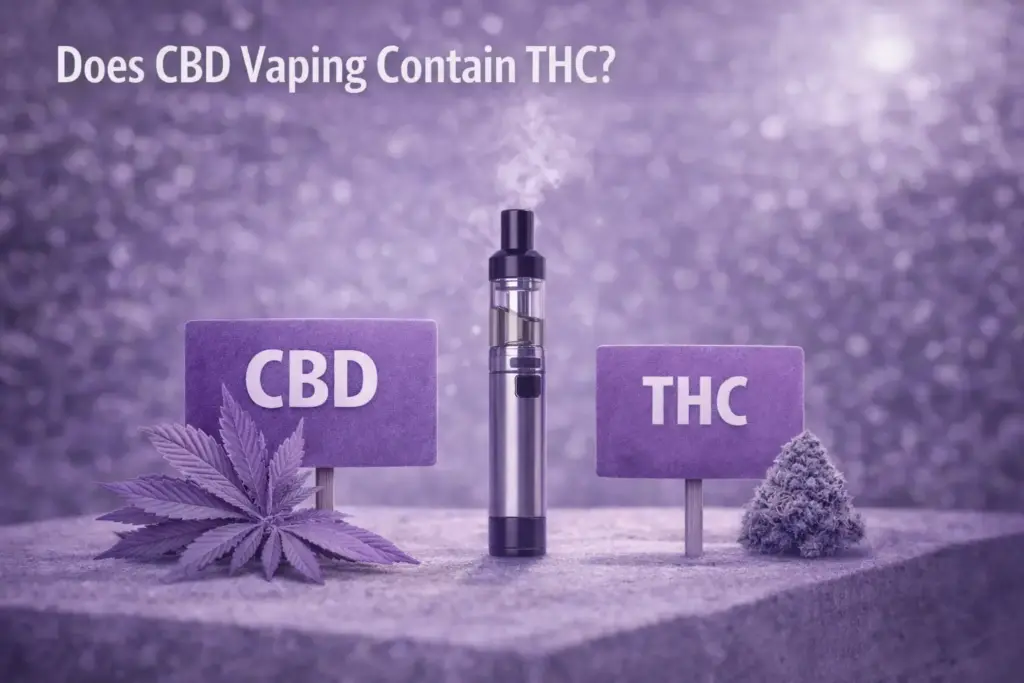
If you’re considering vaping CBD or already enjoy it, you’ve probably wondered whether your CBD vape contains THC.
It’s a fair question, especially when product labels can be confusing and the legal landscape keeps shifting. The short answer is that it depends entirely on the type of CBD extract used and how rigorously the product was manufactured.
In this guide, we’ll break down exactly what determines THC content in CBD vape products, how to verify what you’re actually inhaling, and what the legal limits mean for you in the UK and beyond.
Some CBD vapes contain trace amounts of THC, while others are designed to be completely THC free.
The difference comes down to the type of CBD extract used and the quality controls applied during manufacturing.
When you buy a CBD vape, you’re typically getting one of three extract types: CBD isolate (no THC), broad spectrum CBD (THC removed), or full spectrum CBD (contains trace THC within legal limits).
In the UK, legal CBD products must keep THC content below 0.2%, while US regulations allow up to 0.3%. These levels are far too low to produce any psychoactive effects for most people.
Here’s what you need to know at a glance:
The bottom line: not all CBD vapes are created equal. If avoiding THC completely is important to you, stick to reputable brands that provide recent lab testing and clearly label their products as isolate or broad spectrum.
If you are choosing between formats, it can also help to compare CBD vape cartridges, refillable devices, and CBD vape starter kits before you buy.
Both CBD (cannabidiol) and THC (tetrahydrocannabinol) are cannabinoids found naturally in the cannabis plant.
They share a similar molecular structure, but the way they interact with your body’s endocannabinoid system is fundamentally different, which is why one gets you high and the other doesn’t.
CBD basics:
THC basics:
The key distinction for CBD vaping is this: legal CBD vape products are derived from industrial hemp plant varieties that naturally contain very low THC levels, typically under 0.2% in the UK or 0.3% in the US.
These are not the same as high-THC marijuana strains. When you consume CBD through a vape pen, you’re getting the potential benefits of CBD without the intoxicating effects of THC, provided the product is properly made and accurately labelled.
If you want a wider introduction to how vaping CBD works, you can also read our guide to CBD vape cartridges in the UK and answers to common CBD vape questions.
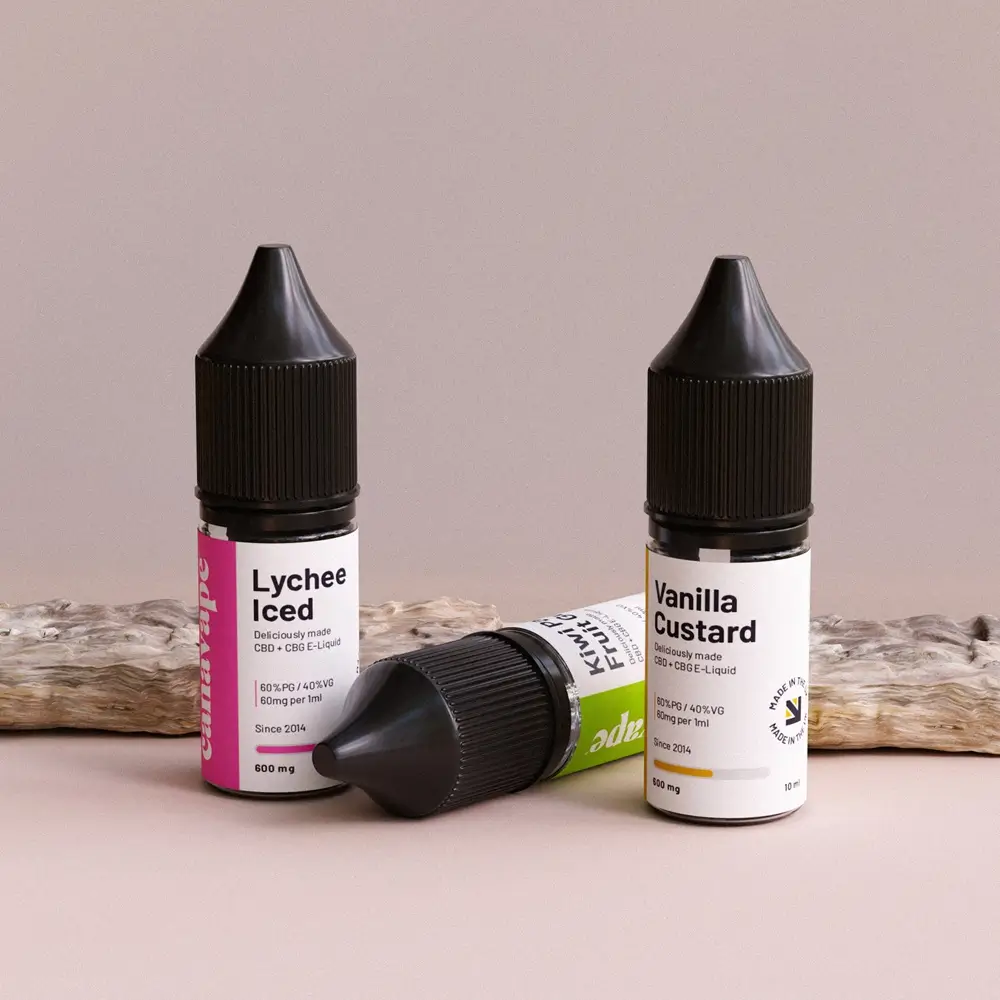
The THC content in your CBD vape is primarily determined by the extract type and how compliant the manufacturer is with quality standards.
Understanding these categories helps you make an informed choice, especially if you need to avoid THC entirely.
The risk hierarchy is straightforward: isolate carries the lowest THC risk, followed by legitimate broad spectrum, with full spectrum containing intentional, though legal, trace amounts.
Labels alone aren’t enough to guarantee what’s in your CBD e liquid. Independent testing is the only reliable method to verify THC content, and unfortunately, mislabelling in the CBD industry remains a documented problem.
What to look for on CBD vape labels:
Understanding Certificates of Analysis (COAs):
A Certificate of Analysis is a lab report from a third-party testing facility that breaks down exactly what’s in a product. Reputable brands publish these on their website or include a QR code on packaging.
When reviewing a COA, check for:
The mislabelling problem is real:
Research has consistently found that many CBD products contain different cannabinoid levels than their labels claim.
A study examining CBD vaping liquids detected unlabelled delta-9 THC alongside synthetic cannabinoids and other contaminants in products marketed as pure CBD. Some products tested far exceeded legal THC limits despite THC-free claims.
Avoid products that:
If you are unsure what a good CBD vape page should tell you, our CBD vape juice guide and our first device guide both show the sort of details worth checking before purchase.
Confusion around CBD vapes and THC is widespread, fuelled by inconsistent product quality, sensational headlines, and social media misinformation. Let’s separate fact from fiction.
Misconception 1: “All CBD vapes are totally THC-free”
The reality: Only CBD isolate and properly manufactured broad spectrum products are effectively THC free. Full spectrum CBD vapes intentionally contain trace THC (under 0.2% in the UK) as part of the natural hemp cannabinoid profile.
Assuming any CBD vape is automatically THC-free can lead to unexpected results, especially with drug testing.
Misconception 2: “Any THC, even 0.2%, will get you high”
The reality: The amounts of THC in legal CBD vapes are far too low to produce intoxication. Compare 0.2% THC to recreational cannabis products containing 10 to 25% THC. You’d need to vape an implausible quantity to experience psychoactive effects.
The THC levels in compliant CBD products simply don’t reach the threshold required to trigger a high.
Misconception 3: “If it’s legal, it must be accurately labelled”
The reality: There’s a significant gap between regulations and enforcement. Studies examining CBD vape products have found widespread mislabelling, with some products containing considerably more THC than declared, sometimes exceeding legal limits entirely.
UK regulators set standards, but enforcement remains inconsistent. Legal status doesn’t guarantee accuracy.
Misconception 4: “CBD vapes can never show up on a drug test”
The reality: Drug tests look for THC metabolites (THC-COOH), not CBD itself. While isolate and broad spectrum CBD vapes are unlikely to trigger a positive drug test, heavy long-term use of full spectrum products could theoretically accumulate enough THC metabolites to cause issues with sensitive testing protocols.
If you face regular testing, a THC-free option is the safer choice.
Misconception 5: “You can tell if a CBD vape has THC by how it feels”
The reality: CBD’s effects, relaxation, calm, and potential stress relief, come from CBD itself, not trace THC. At legal levels, THC content is too low to produce any subjectively noticeable effect. You cannot reliably feel whether your CBD vape contains 0.1% or 0% THC. Lab testing is the only way to know.
If you want to understand how cannabinoids work together, this guide to the entourage effect adds useful context when comparing isolate, broad spectrum, and full spectrum formulas.
THC regulations vary significantly by jurisdiction. Before buying CBD vape products, especially online or when travelling, you need to understand what’s legal where you are.
United Kingdom:
European Union:
United States:
Key takeaways for legal compliance:
For UK readers, our CBD vape legality guide covers the legal side in more detail.
This is one of the most common concerns for people considering CBD vaping, especially those in careers or sports where drug testing is routine.
The short answer is that legal THC levels won’t get you high, but they could theoretically affect certain drug tests under specific circumstances.
Understanding intoxication risk:
How drug tests work:
When drug testing matters:
Recommendations for those concerned about testing:
If strength selection is part of your concern too, our CBD vape strength guide may help you choose more confidently.
While THC content is a primary concern, it’s only one piece of the CBD vape safety puzzle. What else is in your vape, and how it’s manufactured, matters just as much.
Standard CBD vape ingredients:
Ingredients to avoid:
What quality testing should cover:
Beyond cannabinoid profiles, comprehensive third party lab reports should screen for:
Vaping-specific health considerations:
Research on CBD vaping is still developing. Studies have found that vaping CBD can cause lung inflammation independent of THC content.
Some research suggests CBD vape aerosols may trigger notable acute lung effects, while the World Health Organization has noted that although CBD itself has a good safety profile, delivery by inhalation still requires more research.
Practical safety guidance:
You may also find our guide to what makes a strong CBD vape useful when comparing concentration, formulation, and overall product quality.
Here are quick answers to the most common questions about CBD vapes and THC content.
Does CBD vape contain THC? It depends on the extract type. CBD isolate and properly made broad spectrum CBD vapes are designed to be THC-free. Full spectrum CBD vapes intentionally contain trace THC within legal limits (under 0.2% in the UK, 0.3% in the US).
Can you get high from a legal CBD vape? No. Legal THC levels in CBD vapes are far too low to cause a marijuana-style high. You’d need to consume unrealistic quantities to experience any psychoactive effects.
Will a CBD vape make me fail a drug test? Isolate and verified broad spectrum CBD vapes are unlikely to trigger THC-specific drug tests. Heavy, long-term use of full spectrum products could theoretically increase risk with very sensitive testing, though this remains uncommon.
How do I check if my CBD vape has THC? Look for the extract type on the label (isolate, broad spectrum, or full spectrum) and verify with a third-party COA listing delta-9 THC content. If you want THC-free, look for ND in the THC field.
Is it legal to buy CBD vapes with THC in the UK? Yes, provided the THC content stays below 0.2% and the product complies with UK rules. Anything above that threshold is not compliant.
Which CBD vapes are best if I must avoid THC completely? Choose clearly labelled CBD isolate or broad spectrum products from reputable brands that provide recent, batch-specific lab reports confirming non-detectable THC. Avoid vague hemp vape products without detailed cannabinoid breakdowns.
How do you vape CBD safely? Start with a low CBD concentration, take short sessions, and gradually increase if needed. Only use CBD e-liquid products specifically designed for vaping, never oral CBD oils. Purchase from reputable sources with transparent testing.
Understanding whether your CBD vape contains THC comes down to three factors: the extract type, the manufacturer’s quality controls, and verification through independent lab testing.
If THC and CBD distinctions matter for your work, sport, or personal preference, stick with verified THC-free products and keep documentation of what you’re using.
The CBD vape market has matured significantly, but informed consumers who demand transparency still get the best outcomes.
