£429.99
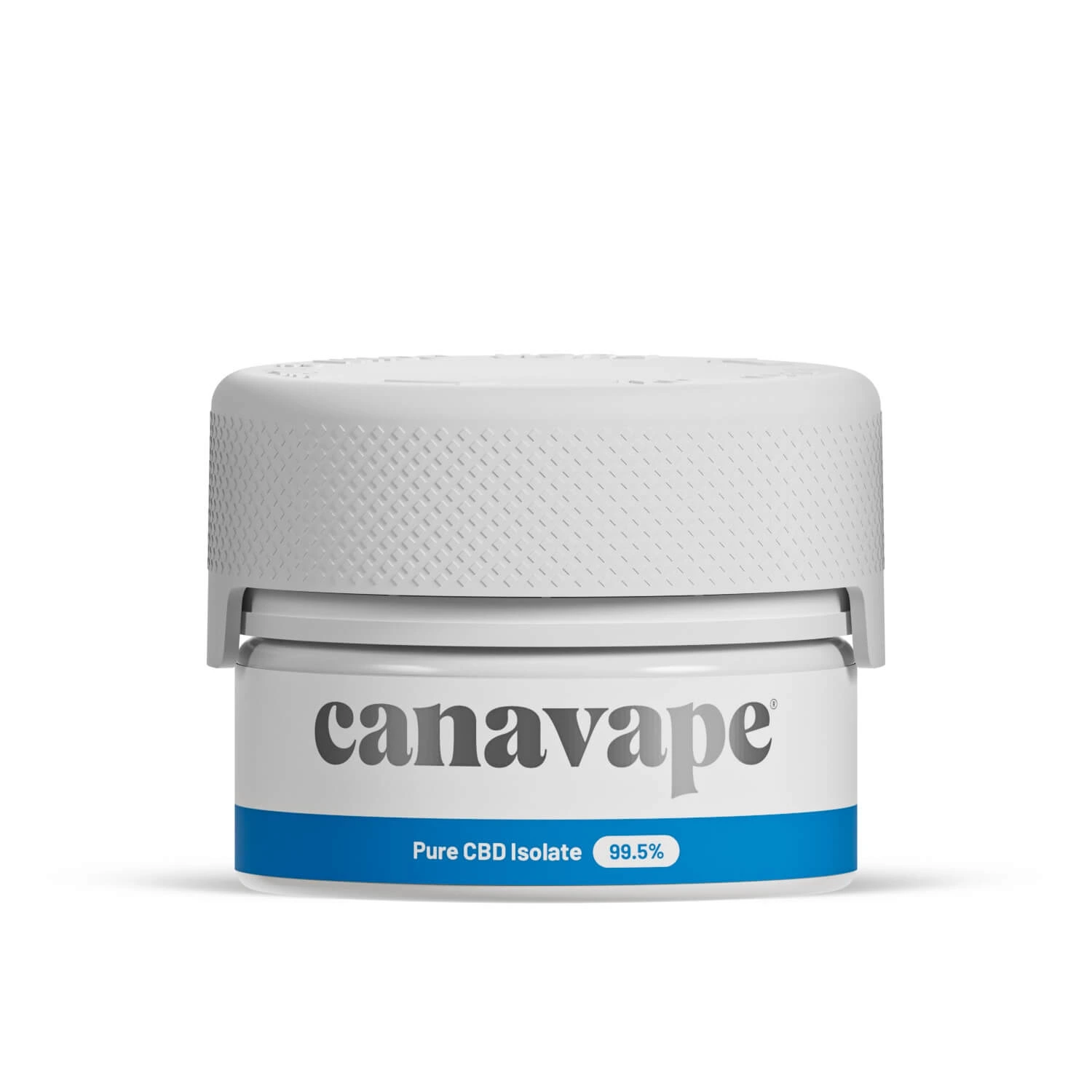
Canavape CBD isolate 100g is a bulk quantity of 99%+ pure cannabidiol powder for larger formulation programmes and planned ingredient supply. It is the largest single-size CBD isolate pack currently listed in the range.
The 100g format provides material for projects that have moved beyond a small initial assessment and require an organised allocation across development batches, repeat work, testing and retained samples.
Supplied as a white crystalline powder with a neutral aroma, this ingredient allows cannabidiol to be considered separately from the broader composition of a mixed extract. Bulk quantity does not change the need to use the batch assay, calibrated weighing equipment and an appropriate formulation assessment.
CBD isolate is cannabidiol refined into a highly purified crystalline form. During refinement, CBD is separated and concentrated from other constituents of the original extract.
The result is an ingredient focused on cannabidiol rather than the broader cannabinoid composition associated with many hemp extracts. Exact residual cannabinoid results should be checked against the relevant batch analysis.
“Powder” and “crystals” often describe the same type of isolated CBD material. Powder refers to its finely divided crystalline form rather than a different cannabinoid ingredient.
Select a 100g pack when the expected material requirement supports a larger allocation. Start with the planned number of batches, the ingredient amount needed for each one and any additional material reserved for analytical work or retention.
A single larger pack can support an organised project supply, but its contents still need to be tracked as they are issued and used. The available amount should be reconciled against development records rather than estimated from the container’s appearance.
This pack contains twice the material weight of the 50g CBD isolate option and ten times that of the 10g pack. It is a larger quantity of the stated 99%+ ingredient, rather than a stronger purity grade.
If the project is still exploratory, a smaller pack may be sufficient. Review the complete CBD isolate range to match the material allocation to your actual development stage.
A purity of 99%+ means that cannabidiol accounts for at least 99% of the material by weight. For precise formulation calculations, use the CBD assay reported for the batch supplied.
At a 99% CBD assay, 100g of isolate powder contains approximately 99,000mg of cannabidiol. This is an illustrative calculation at the stated minimum purity, not an exact batch result. Use the measured CBD assay for precise project calculations.
The 100g pack contains 100,000mg of isolate material by weight. That material weight should not automatically be treated as the same amount of pure CBD.
Use calibrated weighing equipment appropriate to the quantities involved. Record ingredient weights, batch references and calculations so that development results can be reviewed and repeated.
CBD isolate concentrates cannabidiol as an individual compound. A CBD distillate is a refined extract that may contain CBD alongside other cannabinoids.
Isolate is useful when the project calls for a defined CBD ingredient. Distillate may be considered when the wider extract composition is part of the formulation brief. Neither is universally better; the appropriate choice depends on the required specification.
Explore our CBD distillate range to compare the available extracts.
CBD isolate and CBG isolate contain different cannabinoids: cannabidiol and cannabigerol respectively. They can be evaluated as separate ingredients or considered together in development projects where the intended application supports their use.
When assessing a combination, calculate each ingredient’s contribution using its own measured potency. Equal powder weights do not necessarily provide exactly equal cannabinoid amounts.
View our CBG isolate range if your project also requires a concentrated cannabigerol ingredient.
Review the documentation relevant to the material supplied, including the cannabinoid profile, batch reference and reporting units. Any THC or other residual cannabinoid result should be read alongside the laboratory’s reporting limits.
A potency report and a contaminant report answer different questions. Check the scope of the available analysis rather than assuming that one document covers every quality parameter.
Visit our lab reports page for published analytical information. If you need help identifying documentation for your order, contact us.
Before releasing a bulk ingredient into development work, check that the product identity, quantity and batch reference match the order and accompanying documentation. Record the date received and any condition checks required by your own procedures.
Keep the material identification with the container throughout its use. If your process transfers powder into another suitable container, preserve the original batch reference and the information needed to trace that transfer. Clear identification is particularly useful when several cannabinoid ingredients or more than one batch are held in the same work area.
Prepare a material allocation for the complete project, then review it against actual use. The initial estimate should distinguish powder intended for formulations from powder reserved for testing, retained samples or other documented purposes.
Account for realistic transfer losses without assuming a universal allowance. The appropriate estimate depends on the equipment, handling steps and quantities involved. Recording actual recovered and unused material helps make the next allocation more accurate.
Where several trial formulations are being compared, assign clear identifiers to the trials and link them to their ingredient records. This allows observations to be traced back to the actual material used rather than to a general product name.
Choose weighing equipment according to the amount being measured and the acceptable uncertainty in that measurement. A balance suitable for weighing a complete bulk container may not be suitable for the smallest portion taken from it.
Use an appropriate tare procedure and record the actual amount transferred. Avoid relying on scoop size, visual estimates or an assumption that powder flows the same way after every opening. Keep tools and transfer surfaces clean and dry.
When the ingredient is incorporated into a formulation, establish how uniformity will be assessed. A clear appearance or apparently complete dispersion does not establish the cannabinoid content of every part of a batch. Select checks appropriate to the formulation and its development stage.
Changing the amount made can alter mixing, transfer and sampling conditions. Keep a record of the batch size and processing sequence, then identify which variables have changed from the previous trial.
A larger quantity of the same ingredient does not, by itself, demonstrate that a formulation will remain uniform or physically stable. Assess the resulting material under the storage and handling conditions relevant to the project. Investigate separation, crystallisation or unexpected changes using the actual formulation records.
Use the outcome of these checks to decide what further development is needed. Separate ingredient evaluation from the assessment required for a finished product and its intended market.
A larger ingredient allocation benefits from a clear issue record. Identify each project or development stream receiving material, then record the quantity issued, the date and the person or process responsible for the transfer within your own procedures.
This does not require every project to use the same formulation. It means the raw material can be traced consistently even when different teams or work areas are comparing different approaches. Keep separate trial records so that observations from one formulation are not attributed to another.
If retained samples are part of the quality plan, account for them before allocating the full container to development batches. Record what was retained, why it was retained and how it will be stored. Retained powder and retained formulated samples answer different questions and should be identified separately.
Use the same discipline for unused material returned from a trial area. Follow your own quality procedures to decide whether that material can be returned to stock. Do not mix unidentified powder into the original supply or remove its connection to the original batch record.
When a further supply arrives, compare its documentation with the material previously used. The stated 99%+ purity standard does not mean every measured analytical result must be identical. Update the CBD calculation using the assay for the new batch.
Consider whether the existing development conclusions need to be checked against the new supply. The appropriate review depends on the project specification, observed material characteristics and any changes in the supporting information. Keep the assessment with the development records so that later work can distinguish an ingredient batch change from a formulation change.
If you need recurring supply, contact Canavape with the expected quantities, ordering intervals and documentation requirements. Availability should be confirmed for the actual requirement rather than assumed from one purchase.
Follow the product label and accompanying technical documentation. Keep the container securely closed and protect the powder from moisture, contamination, excessive heat and direct sunlight.
This product is supplied as 99%+ CBD isolate. Refer to the relevant batch analysis for the measured cannabidiol concentration and residual cannabinoid profile.
This listing supplies 100g of CBD isolate powder with 99%+ cannabidiol purity. The pack weight refers to the complete ingredient. Check the displayed price and availability before ordering.
No. CBD isolate is a concentrated crystalline ingredient. A finished CBD oil is a formulation containing CBD in a carrier. They have different specifications and intended uses.
Review the relevant cannabinoid report for the batch supplied. A result described as “not detected” means it was not detected within the reporting capability of that test, rather than establishing absolute zero.
They provide different ingredient profiles. Isolate is selected for concentrated cannabidiol, while a full spectrum extract contains a broader composition. Choose according to your formulation requirements and supporting specifications.
Yes. Browse our CBD isolate category for other listed sizes, or contact Canavape to discuss your supply requirements.
Order the 100g CBD isolate pack for larger formulation programmes and bulk material planning. For help comparing quantities or identifying the documentation needed for your project, contact Canavape before ordering.
This product is supplied as a raw cannabinoid ingredient for formulation and development work, rather than a finished consumer preparation. Suitability for a particular application must be established from the product documentation and the relevant safety and regulatory assessment. Ingredient purity alone does not establish approval for a finished-product use.
| Size | 100g |
|---|

Message us directly
I will be back soon